

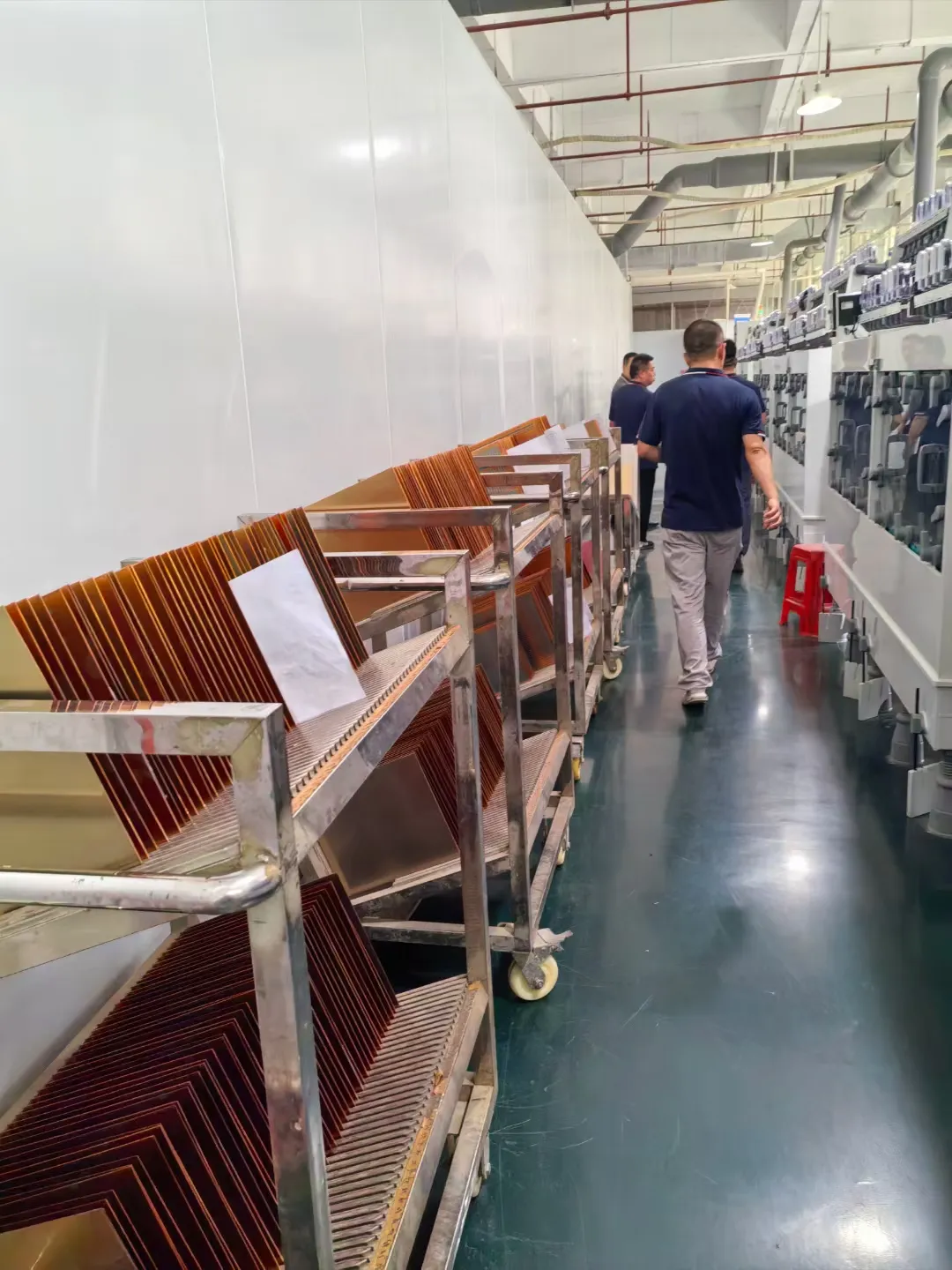
"Industrial PCB production" is usually explained as a list of process steps. That is the least useful version of the answer. Every fabricator runs inner-layer imaging, lamination, drilling, plating and electrical test. The steps are not the difference. The difference is how tightly each step is controlled, and whether you can prove it after the boards ship.
This guide is written for the buyer or engineer who has to approve a supplier, not for someone learning what a PCB is. YC PCB has produced rigid, metal-core, multilayer and HDI boards for 20+ years and ships to 20+ countries; the checks below are the ones that actually separate a capable industrial supplier from a cheap one.

What "Industrial" Changes Compared With Consumer Electronics
The failure model changes before the process does
Industrial boards are judged on a different failure model. A consumer device that fails after two years is an inconvenience. A control board inside a pump, an inverter or a lighting fixture that fails in the field is a warranty claim, a production stop, and sometimes a safety issue.
| Requirement | Consumer-grade board | Industrial-grade expectation |
|---|---|---|
| Operating temperature | 0–40 °C ambient, short life | Wide ambient swings, thermal cycling over years |
| Life expectancy | 2–3 years | 5–15 years, often 24/7 duty |
| Batch consistency | Acceptable lot-to-lot variation | Same stack-up and process window across repeat orders |
| Traceability | Rarely requested | Panel, date code and material lot traceable |
| Test coverage | Sample inspection | Electrical test on 100%, plus AOI and project-specific checks |
| Documentation | Not expected | Stack-up, material declaration, test record, change notification |
What buyers are actually paying for
Nothing in that table requires exotic equipment. It requires process discipline and a paper trail — which is exactly what a buyer should be verifying. Two factories can run identical equipment and produce different field failure rates, because one records what it did and the other does not.
The Production Flow, and Where It Actually Breaks
The sequence below is standard. The right-hand column is what matters: where the process fails, and what you should ask for as evidence.
| Stage | Typical failure mode | What to ask the supplier |
|---|---|---|
| File and DFM review | Ambiguous Gerber, missing drill, unstated copper weight | Do you return DFM notes before quoting, or only after payment? |
| Material preparation | Substituted laminate or prepreg of lower grade | Which laminate family and Tg are you quoting, and will it be on the certificate? |
| Inner-layer imaging and etching | Trace width drift, under-etch, registration error | What is your etch tolerance and AOI coverage on inner layers? |
| Lamination | Voiding, resin starvation, thickness drift, layer shift | Do you record lamination cycle parameters per lot? |
| Drilling | Hole wall smear, nail-heading, drill breakage on small vias | What is your minimum drill and aspect ratio, and how is smear controlled? |
| Plating | Thin plating in high-aspect holes, void in copper | What plating thickness is guaranteed in the hole barrel? |
| Outer layer and solder mask | Mask bleed, misregistration on fine pitch | How is mask registration checked on 0.1 mm pitch parts? |
| Surface finish | ENIG black pad, HASL thickness variation, OSP shelf life | Which finish do you recommend for my storage and reflow conditions? |
| Routing and V-scoring | Burrs, delamination, depth control on scored panels | What is your scoring depth tolerance? |
| Electrical test and final inspection | Escaped opens/shorts, cosmetic-only inspection | Is electrical test 100% or sampled? What is your acceptance standard? |
A supplier who can answer the middle column without checking a document is either very experienced or guessing. A supplier who answers "we follow IPC Class 2" to all ten questions has not answered any of them.
Which three stages produce most escapes
Across incoming inspection on industrial orders, three stages account for the majority of defects that reach the customer: lamination (voiding, resin starvation, layer-to-layer shift), plating (thin copper in high-aspect-ratio holes), and surface finish (ENIG black pad, HASL thickness spread). All three look acceptable on a finished board. None of them can be judged by eye, which is why the evidence has to be a record rather than an inspection.
What each question is really testing
Every question in the right-hand column has a second purpose: it reveals whether the supplier has a number for that variable at all. A supplier who says "we control etch tightly" has no figure. A supplier who says "trace width tolerance ±10% on 1 oz inner layer, AOI 100% on inner layers" is quoting a process window — and a process window can be audited. Ask for the number, then ask what happens when a lot falls outside it.
How Batch-to-Batch Consistency Is Verified
Industrial buyers rarely place one order. They place the same part number for years, and the risk is not the first lot — it is the fifth.
First article, then a frozen window
The first article establishes the reference. What matters afterwards is whether the supplier freezes the inputs that produced it: laminate supplier and grade, prepreg build, lamination cycle, plating line, surface finish bath, and the electrical test program. If any of those can change without notice, the first article proves nothing about lot five.
SPC on the variables that drift
Ask which parameters are charted and what the control limits are. Typical candidates are plated copper thickness in the hole, dielectric thickness after lamination, trace width after etching, and solder mask thickness. A supplier running statistical process control can show you a chart with limits and out-of-control actions. A supplier without it can only show you a passing lot.
Retained samples and records
Retained coupons or samples per lot, kept for an agreed period, are the cheapest insurance in the relationship. Combined with date codes on the panel and a material lot reference, they let you investigate a field failure months later instead of arguing about it. When a supplier cannot produce a retained sample, the discussion ends there.
What a Fabricator Cannot Fix
A capable supplier will tell you what is outside its control, because pretending otherwise costs both sides money.
- A design that violates capability. If the annular ring, aspect ratio or spacing is below the process limit, no amount of process control recovers the yield. This is why design-rule review before quoting matters more than price.
- A material the laminate supplier no longer makes. Substitution is sometimes unavoidable; a silent substitution is not. The fix is a change notification clause, not a promise.
- Thermal or mechanical limits of the chosen material. FR4 will not become a heat spreader because the design needs one. That is a material decision, made before fabrication.
- Your assembly process. Reflow profile, handling and storage downstream can destroy good boards. Fabrication defects and assembly defects are different problems and should be separated before you escalate.
Seven Things to Verify Before You Approve a Supplier
- Capability boundaries, not capability claims. Every factory says it makes 6-layer boards. Ask what they decline: minimum annular ring, minimum via, maximum aspect ratio, thickest copper they will laminate, largest panel. Suppliers who quote limits are usually telling the truth.
- Who reviews the file. DFM review by a salesperson is not DFM review. Ask for the name and role of the engineer who signs off the pre-production review.
- The stack-up document. For anything above two layers, request the stack-up before production. If the supplier cannot produce one with dielectric thickness and copper weight, impedance and controlled-depth drilling are guesses.
- Material identity. Laminate grade, Tg, and metal-core dielectric are the three substitutions that quietly change performance. Ask that the quoted material appear on the delivery certificate.
- Test coverage per board type. Bare PCB: electrical test plus AOI is the baseline. Assembly: X-Ray for hidden joints, ICT or FCT where the design allows. Get the coverage stated in writing, per order.
- Repeat-order control. Industrial buyers place the same part number for years. Ask how the process window is frozen — same stack-up, same surface finish, same test program — and how a change is announced.
- Change notification. The most expensive supplier failure is a silent change: a new laminate, a different plating line, a revised finish. A written PCN (product change notification) commitment is worth more than a lower unit price.
Where Most Buyer Guides Stop Short
Batch-to-batch drift is invisible in samples. A first article can pass every check and a fifth lot can fail, because the process window moved. Ask for the last three lots' electrical test yield on a comparable part.
Cleanliness is not on the datasheet. Ionic contamination and flux residue cause field failures that no AOI catches. For conformal-coated or high-impedance assemblies, ask how cleanliness is verified and whether ionic testing is available.
"RoHS compliant" is not a material declaration. For industrial and export programmes you need the actual material report and, where applicable, REACH SVHC statements — not a logo.
Panel design drives your assembly yield. Fiducials, tooling holes, edge clearance and panelization are decided at fabrication but paid for at assembly. Review the panel drawing, not just the board drawing.
Delivery promises are the weakest data point. Any date quoted before file review is a placeholder. Ask what the date depends on — material stock, layer count, finish, test scope — and get it re-confirmed after DFM.
Buyer Checklist: Approving an Industrial PCB Supplier
- Send the full file set — Gerber, drill, board outline, stack-up, impedance targets, finish, copper weight, quantity.
- Ask for DFM feedback before the quote is finalised, and read the notes rather than the price.
- Request the capability matrix in writing, including limits the supplier will not cross.
- Confirm material grade and finish in the quotation document, not only in conversation.
- Agree the test plan per board: electrical test, AOI, X-Ray, ICT/FCT, and who pays for what.
- Ask for a repeat-order control statement and a change-notification commitment.
- Run a pilot lot on the real panel design before committing volume.
The Evidence Table: What to Ask For, What Counts as a Fail
This is the part most supplier questionnaires miss. A document request is not an audit; each item needs a pass condition and a fail condition, agreed before the order.
| What to ask for | What to look at | Counts as a pass | Counts as a fail |
|---|---|---|---|
| Capability matrix | Stated minimums, not maximums | Numbers with units, plus limits the supplier declines | "We can do anything", no figures |
| Stack-up drawing | Dielectric thickness per layer, copper weight, material name | Complete build-up with material grade and Tg | Generic table, "standard 1.6 mm 4-layer" |
| DFM report | Issues found, not just "no problem" | At least one note on your actual files | Blank report returned in minutes |
| Material certificate | Laminate grade and lot on the delivery | Matches the quotation line by line | Grade absent or "equivalent" |
| Test record | Coverage and acceptance standard | 100% electrical test stated, plus AOI scope | "Sample inspection" unqualified |
| Last three lots | Yield or reject rate on a comparable part | Trend that is stable or improving | Refusal to share, or one lot only |
| Change notification | Written PCN commitment | Named contact and lead time before change | Verbal assurance only |
FAQ
What separates an industrial PCB supplier from a consumer-grade one?
Process control and documentation, not equipment. Industrial buyers need a frozen process window, per-lot records, retained samples and change notification, because a field failure costs far more than the board. A supplier that cannot show those records is a consumer-grade supplier with industrial customers.
How do I verify batch-to-batch consistency without visiting the factory?
Ask for three things: the last three lots' test yield on a comparable part number, the list of parameters under statistical process control with their limits, and retained samples per lot. If the supplier cannot produce all three, treat consistency as unproven regardless of how good the samples look.
What documents should arrive with an industrial PCB delivery?
At minimum: a delivery note with date code and lot reference, the material declaration for the laminate used, the electrical test result for the lot, and a certificate of conformity stating the specification shipped against. For export programmes, add the RoHS material report and, where applicable, REACH SVHC statement.
Does a higher unit price guarantee better industrial quality?
No. Price tracks layer count, material, finish and test scope more than it tracks discipline. The reliable signal is refusal behaviour: a supplier that declines work outside its capability, and writes its limits down, is usually the safer choice at any price.
Why YC PCB
- 20+ years of PCB and PCBA manufacturing, exporting to 20+ countries
- Rigid FR4, aluminum and copper metal-core, multilayer (6–32 layer route), HDI, FPC and rigid-flex under one roof
- DFM/DFA engineering review before production, with NDA available for customer IP
- AOI and 100% electrical test on bare boards; X-Ray, ICT and FCT available for assembly projects
- ISO 9001 and UL certification, with RoHS compliance documentation on request
- No MOQ / No MOV on standard boards — special materials and processes are quoted per project
- Dedicated project engineer from quotation through shipment
Get a Quote — Send your Gerber, stack-up, quantity and target date. Our engineers reply with DFM notes, material options and pricing within one working day.


 English
 Japanese
 French
 German
 Spanish
 Italian
 Portuguese
 Russian
 Dutch
 Turkish
