

"Bare PCB" sounds like industry jargon for the obvious. It is actually a precise commercial term: a finished, tested board with no components attached, ready for someone else to assemble. The distinction matters because it decides what arrives in the box, what you must supply, and who is accountable when the finished unit does not work.
This article treats the question as a purchase decision rather than a definition exercise. YC PCB manufactures both bare boards and turnkey assemblies, so the boundary is one we handle on every order.
What Does "Bare PCB" Mean?
What is in the box, and what is not
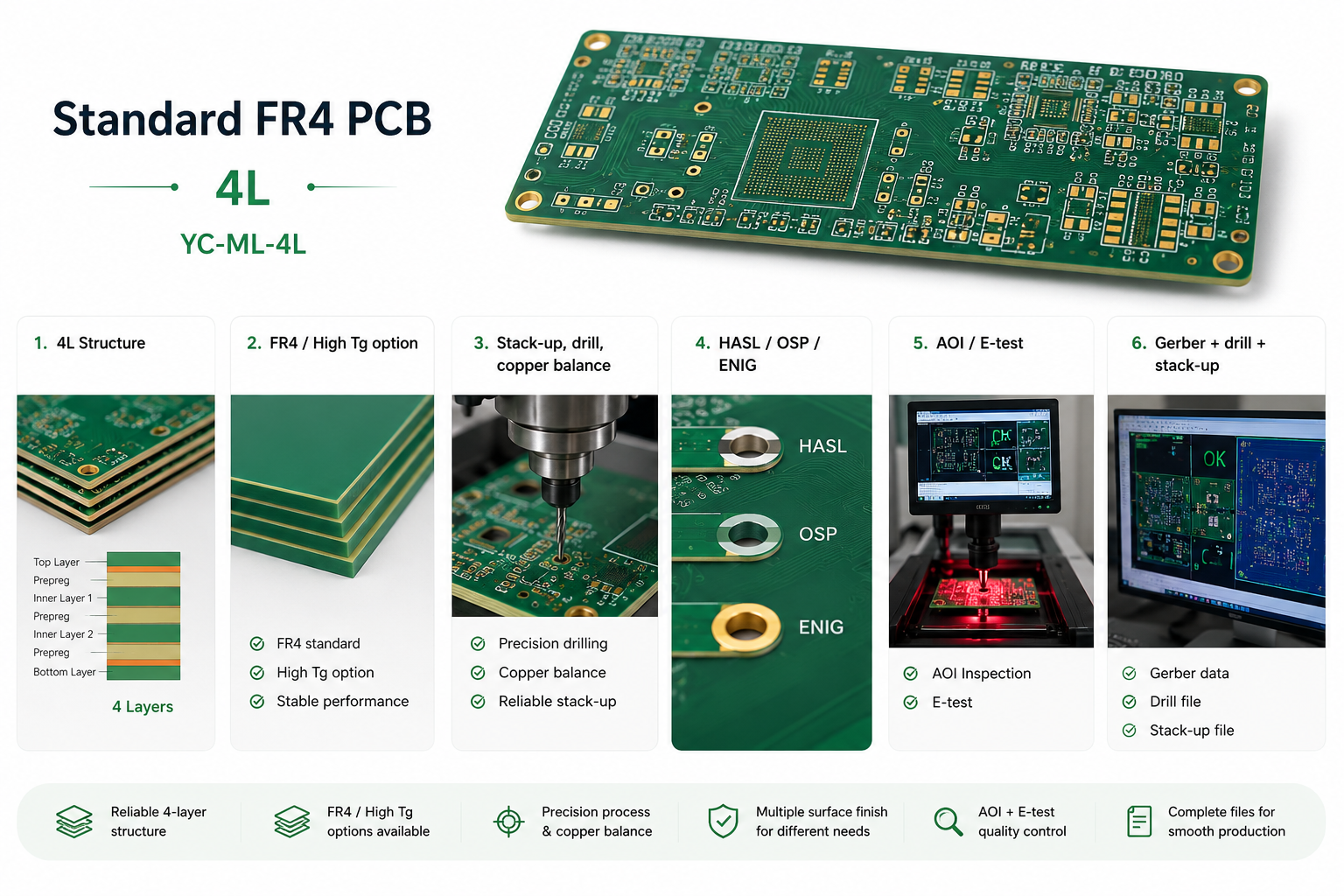
A bare PCB is the completed circuit board before any components are attached. It includes:
- The substrate and copper layers, patterned and laminated
- Drilled and plated holes
- Solder mask and silkscreen legend
- Surface finish (ENIG, HASL, OSP, silver or hard gold)
- Electrical test on the finished board — connectivity, not function
It does not include solder paste, components, soldered joints, programming, coating or functional test.
The word "bare" is about population, not quality. A bare PCB can be a four-layer impedance-controlled board with a tight tolerance and a full test report. It is bare because nothing is soldered to it.
Is There a Difference Between PCB and PCBA?
Yes — and the difference is scope, not just a letter.
| Bare PCB | PCBA | |
|---|---|---|
| What you receive | Unpopulated boards | Boards with components soldered |
| What proves it works | Electrical test (connectivity) | Electrical test plus AOI/X-Ray plus often ICT or FCT |
| Files you must supply | Gerber, drill, outline, stack-up | All of the above plus BOM, CPL, assembly drawing, test spec |
| Who buys components | You or your assembler | Usually the assembly house, under a turnkey model |
| Failure mode if wrong | Opens, shorts, tolerance drift | Wrong part, wrong orientation, cold joint, missing function |
| Typical buyer | OEMs with in-house SMT, or a separate assembly partner | Teams buying a finished sub-assembly |
The practical consequence: a bare board order is a fabrication contract; a PCBA order is a fabrication plus material plus process plus test contract. More parties, more inputs, more responsibility to allocate.
Where the Cost Actually Sits, and Who Owns the Risk
The two purchases have different cost structures and different risk owners, and that is the real reason the decision matters.
| Cost element | Bare PCB order | PCBA order | Who carries the risk |
|---|---|---|---|
| Board fabrication | Supplier, priced per panel area | Supplier, usually bundled | Fabricator |
| Components | You buy, or your assembler buys | Supplier buys under turnkey | Whoever buys them |
| Procurement labour | Yours | Supplier's, priced into the unit | Yours under consignment |
| Stencil and programming | Yours, or the assembler's | Supplier's, amortised in the price | Supplier under turnkey |
| Assembly labour | Your line, or a separate contract | Included | Your assembler |
| Test | Electrical test only | Electrical test plus AOI, X-Ray, ICT, FCT as scoped | Depends on scope, not on model |
| Rework and scrap | Yours once the board ships | Negotiated per defect stage | Whoever caused it — often disputed |
| Boundary disputes | Yours to arbitrate | One supplier, no boundary | Removed by turnkey, priced in |
Two things follow. First, bare board plus local assembly is not automatically cheaper — it removes one margin but adds incoming inspection, procurement labour, shortage chasing and every boundary argument. Second, turnkey does not remove your responsibility, it consolidates it: you still approve the BOM, the alternates and the test scope, and those approvals are the specification.
When Is a Bare PCB the Right Purchase?
Four situations where buying bare boards makes sense:
- You have in-house assembly. If you run your own SMT line, buying populated boards adds a supplier between you and your process.
- You have an established assembly partner. Splitting fabrication and assembly is common when the assembler is qualified and geographically close.
- You are validating the design. A first prototype often needs only the board, so you can check fit and impedance before committing components.
- You need spares or stock. Bare boards store indefinitely in controlled conditions; populated boards carry component lifecycle risk.
Bare boards are also the right buy when the value is in the board itself — a heavy copper, metal-core or high-layer-count design where fabrication is the hard part and assembly is routine.
When Is PCBA the Right Purchase?
Four signs you should buy the assembled unit
- You do not want to manage component sourcing. One party owns the BOM, the alternates and the allocation problem.
- The board is dense or fine-pitch. BGA, QFN and 01005 work needs process capability most teams do not have in-house.
- You want one party accountable for function. If the unit does not work, there is no boundary to argue about.
- Your volume is modest. Distributor pricing, stencils, programming and test fixtures are all easier to amortise through an assembler.
The trade-off is visibility: you see a unit price, not the component breakdown, unless you ask for it.
What Are the Four Main Types of PCBs?
Beyond the bare-versus-populated question, boards divide into four structural families:
- Rigid PCB — FR4 and similar laminates; the default for most electronics
- Flexible PCB (FPC) — polyimide-based, bends and folds, used for tight spaces and moving joints
- Rigid-Flex PCB — rigid sections for components, flexible sections for interconnect, built as one continuous stack-up
- Metal-Core PCB (MCPCB) — aluminum or copper base for thermal management, used in LED lighting and power electronics
Each family has its own DFM rules, its own file requirements and its own failure modes. A supplier competent in one is not automatically competent in another — metal-core fabrication, for example, uses different drilling, routing and dielectric bonding processes than FR4.
Why Are PCBs So Cheap?
Bare PCBs are inexpensive because the process is mature, highly automated and globally competitive at commodity layer counts. A two-layer FR4 board is traded like a commodity, priced on panel area.
The four things that break the commodity pricing:
- Layer count — process time and yield loss rise steeply above six to eight layers
- Material — high-Tg FR4, high-frequency laminate, aluminum and copper cores all cost more
- Tolerance — fine lines, small vias, impedance control and heavy copper are paid for in yield
- Volume — setup is fixed, so small orders carry a large per-unit share
PCBA is never cheap in the same way: components often cost more than the board, and assembly adds stencil, programming, placement and test cost.
Where Buyers Misjudge This Decision
Assuming bare board plus local assembly is cheaper. It can be, but only if you count the hidden costs: incoming inspection, component procurement labour, shortage chasing, and the boundary arguments when a defect's origin is unclear.
Assuming turnkey removes all responsibility. You still approve the BOM, the alternates and the test specification. A turnkey order with an unapproved BOM is a specification you delegated.
Assuming electrical test equals function. A bare board that passes electrical test may still fail once populated. A PCBA that passes ICT may still fail functionally. Test scope must match the risk.
Assuming "bare PCB" means low-spec. Bare boards can carry the most demanding fabrication on the project: heavy copper, tight impedance, metal core, high layer count.
Assuming the same supplier should do both. Sometimes yes, for accountability. Sometimes no, when your assembler is qualified and your fabricator is a specialist in a construction the assembler cannot source.
Decision Checklist
- Decide who assembles, and whether that is a strategic choice or a convenience.
- If bare board: confirm the fabrication drawing, stack-up, finish and test report requirement.
- If PCBA: add BOM, CPL, assembly drawing and test specification to the package.
- Define the supply model — turnkey, partial or consigned — and the alternate-part rule.
- Agree the test scope: electrical test, AOI, X-Ray, ICT, FCT.
- Confirm what is excluded: programming, coating, box build, packaging.
- Ask for the inspection report with the shipment, whichever model you choose.
FAQ
Is a bare PCB cheaper than a PCBA?
Per unit, usually much cheaper — but it is not the same product. A bare board excludes components, assembly, stencil, programming and functional test. Comparing the two prices without adding those items back is comparing a board with a finished assembly.
What does "bare PCB" mean in a quotation?
An unpopulated, finished and electrically tested board: substrate, copper, mask, legend and surface finish, with connectivity tested and no components attached. Anything else — paste, parts, coating, programming — should appear as a separate line.
Who is responsible if a PCBA does not work?
Whoever owns the defect, which is why attribution matters more than blame. In a turnkey order there is no boundary, so the supplier owns the investigation. In a split order the failure could come from the fabrication, your components or the assembly, and that is a joint investigation unless the contract says otherwise.
Can I buy bare boards now and assemble them later?
Yes, and bare boards store well in controlled conditions — but check the surface finish against the storage period. OSP has a limited shelf life and degrades after the first reflow, while ENIG stores far longer. If assembly is a year away, choose the finish for the delay, not for the price.
Why YC PCB
- 20+ years of PCB and PCBA manufacturing, exporting to 20+ countries
- Bare board production across FR4, aluminum and copper metal-core, multilayer (6–32 layer route), HDI, FPC and rigid-flex
- Turnkey assembly with SMT, THT/DIP, mixed technology and BGA/QFN/Micro-BGA support
- AOI and electrical test on bare boards; X-Ray, ICT and FCT for assembly
- DFM/DFA review before production; NDA available for customer IP
- ISO 9001 and UL certification; RoHS compliance documentation on request
- No MOQ / No MOV on standard boards, quoted per project for special materials
Get a Quote — Tell us whether you need bare boards or assembled boards, and send the matching file set with quantity and target date. Our engineers reply with DFM notes and pricing within one working day.


 English
 Japanese
 French
 German
 Spanish
 Italian
 Portuguese
 Russian
 Dutch
 Turkish
