

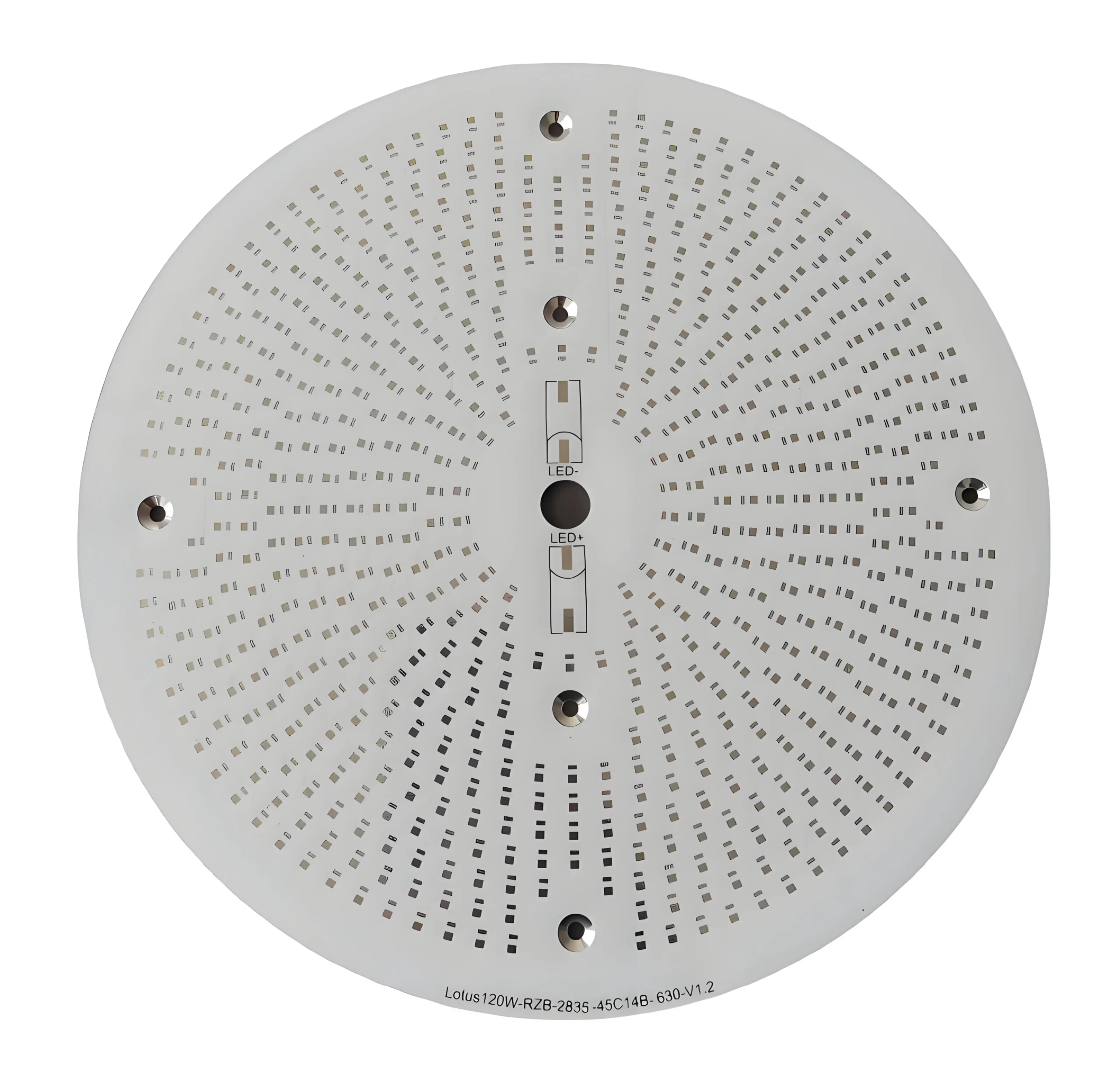
Choosing between an aluminum PCB and an FR4 PCB is not a "which material is better" question — it is a thermal requirement question. The right material depends on how much heat your board has to move, where that heat comes from, and how your assembly handles it.
At YC PCB, we have manufactured both FR4 and metal-core PCBs for over 20 years, shipping to 20+ countries. This guide explains the real decision logic buyers and engineers use, including the points most comparison articles skip: insulation, board thickness, fabrication, assembly, and the actual heat-source path.

What is the difference between FR4 PCB and aluminum PCB?
One is a substrate, the other is a heat path
An FR4 Leiterplatte uses a glass-fiber reinforced epoxy laminate as its base. It is a rigid, cost-effective substrate for general-purpose electronics, from control boards to communication modules.
An aluminum PCB (also called MCPCB — Metal Core PCB) replaces the FR4 core with an aluminum base, topped with a thin dielectric layer and copper circuit. The aluminum base acts as a heat spreader, pulling heat away from components far faster than FR4 can.
| Property | FR4 Leiterplatte | Aluminum PCB (MCPCB) |
|---|---|---|
| Base material | Glass-fiber epoxy laminate | Aluminum + dielectric layer |
| Thermal conductivity | ~0.3 W/mK (typical) | 1.0 – 3.0 W/mK (standard dielectric) |
| Best for | General rigid electronics | Heat-dissipation applications |
| cURL Too many subrequests by single Worker invocation. To configure this limit, refer to https://developers.cloudflare.com/workers/wrangler/configuration/#limits | Control boards, communication modules, LED strips | LED lighting, power modules, automotive electronics |
When Is FR4 PCB Enough?
Many projects do not need an aluminum PCB. If your board has:
- Low to moderate power density
- Components that do not generate concentrated heat (logic, sensors, low-power drivers)
- Adequate air movement or an external heatsink
- No requirement to keep a specific junction temperature under load
...then FR4 is likely sufficient. FR4 is also the right choice when cost is the dominant factor and thermal load is modest.
The key question: is there a concentrated heat source on the board? If yes, the heat path matters — and that is where aluminum PCB becomes worth reviewing.
The four conditions that keep you on FR4
Stated positively, FR4 stays the right answer while all four of these are true:
- Total dissipation on the board is modest and spread over area, not concentrated in a package.
- The component's own thermal path (thermal pad, exposed pad, heatsink on top) does the work.
- Junction temperature stays inside the part's rating at the worst-case ambient, with margin.
- The enclosure has some route for the heat to leave — convection, chassis contact, or an external heatsink.
Break any one of them and the board itself becomes part of the thermal circuit. That is the moment to price a metal-core option, not before.
cURL Too many subrequests by single Worker invocation. To configure this limit, refer to https://developers.cloudflare.com/workers/wrangler/configuration/#limits
cURL Too many subrequests by single Worker invocation. To configure this limit, refer to https://developers.cloudflare.com/workers/wrangler/configuration/#limits
- cURL Too many subrequests by single Worker invocation. To configure this limit, refer to https://developers.cloudflare.com/workers/wrangler/configuration/#limits cURL Too many subrequests by single Worker invocation. To configure this limit, refer to https://developers.cloudflare.com/workers/wrangler/configuration/#limits.
- cURL Too many subrequests by single Worker invocation. To configure this limit, refer to https://developers.cloudflare.com/workers/wrangler/configuration/#limits cURL Too many subrequests by single Worker invocation. To configure this limit, refer to https://developers.cloudflare.com/workers/wrangler/configuration/#limits.
- cURL Too many subrequests by single Worker invocation. To configure this limit, refer to https://developers.cloudflare.com/workers/wrangler/configuration/#limits cURL Too many subrequests by single Worker invocation. To configure this limit, refer to https://developers.cloudflare.com/workers/wrangler/configuration/#limits.
cURL Too many subrequests by single Worker invocation. To configure this limit, refer to https://developers.cloudflare.com/workers/wrangler/configuration/#limits.
The Dielectric Layer Decides More Than the Aluminum Does
Buyers compare the aluminum base and stop there. In practice the dielectric layer — the thin insulating film between the copper circuit and the metal base — is the limiting component in the thermal path. It is also the part of an MCPCB quote that is most often left unspecified.
| Dielectric parameter | Typical range | Why it matters | What happens if you leave it unspecified |
|---|---|---|---|
| Thermal conductivity | ~1.0–3.0 W/mK for standard grades; higher for specialty films | Sets how much heat crosses from copper to the metal base | Supplier quotes the cheapest film that passes insulation test |
| Thickness | Tens of microns, commonly 75–150 µm | Thinner layer conducts better but lowers breakdown voltage | Either an over-thick layer (poor thermals) or a marginal one (hi-pot risk) |
| Breakdown voltage | Specified in kV, tested at a defined voltage and time | Determines the isolation margin for mains-referenced circuits | Compliance risk, and a safety issue rather than a quality issue |
| Thermal resistance | Derived from conductivity and thickness | The number that belongs in a thermal model | Model input becomes a guess, so the simulation is meaningless |
| Peel strength and Tg | Film-specific | Survival through reflow and thermal cycling | Delamination between copper and dielectric after assembly |
Two practical consequences. First, a higher-conductivity aluminum has no effect if the dielectric is thick. The two numbers multiply into thermal resistance; quoting one without the other tells you nothing. Second, high breakdown voltage and low thermal resistance pull in opposite directions. For mains-referenced designs the insulation requirement wins, and the answer is usually a thicker or higher-integrity dielectric with a larger copper area to compensate.
Cost: Where the Money Actually Goes
Aluminum boards cost more per square metre than FR4 at the same layer count, but per finished assembly the comparison can reverse. The honest way to compare is by cost driver, not by unit price.
| Cost element | FR4 | Aluminum (MCPCB) | Where the difference lands |
|---|---|---|---|
| Bare board | Baseline | Higher — special material, separate line, tighter process | Per-board price |
| Heatsink | Usually needed for power designs | Often reduced or eliminated — the base is the spreader | System bill of materials |
| Assembly | cURL Too many subrequests by single Worker invocation. To configure this limit, refer to https://developers.cloudflare.com/workers/wrangler/configuration/#limits | cURL Too many subrequests by single Worker invocation. To configure this limit, refer to https://developers.cloudflare.com/workers/wrangler/configuration/#limits | cURL Too many subrequests by single Worker invocation. To configure this limit, refer to https://developers.cloudflare.com/workers/wrangler/configuration/#limits |
| cURL Too many subrequests by single Worker invocation. To configure this limit, refer to https://developers.cloudflare.com/workers/wrangler/configuration/#limits | cURL Too many subrequests by single Worker invocation. To configure this limit, refer to https://developers.cloudflare.com/workers/wrangler/configuration/#limits | cURL Too many subrequests by single Worker invocation. To configure this limit, refer to https://developers.cloudflare.com/workers/wrangler/configuration/#limits | cURL Too many subrequests by single Worker invocation. To configure this limit, refer to https://developers.cloudflare.com/workers/wrangler/configuration/#limits |
| cURL Too many subrequests by single Worker invocation. To configure this limit, refer to https://developers.cloudflare.com/workers/wrangler/configuration/#limits | cURL Too many subrequests by single Worker invocation. To configure this limit, refer to https://developers.cloudflare.com/workers/wrangler/configuration/#limits | Metal routing and scoring add tooling complexity | Low-volume programmes |
| Thermal design effort | May need heatsink selection and TIM study | Dielectric and base thickness become the design variables | Engineering hours |
The decision rule: compare total cost per acceptable unit at the thermal target, not price per board. An aluminum board that removes a machined heatsink and two thermal pads often wins even at twice the bare-board price. An aluminum board that still needs the heatsink has paid twice.
Aluminum PCB vs FR4: What Comparison Articles Usually Miss
Five variables the tables leave out
Most articles compare only the thermal conductivity numbers. But real PCB sourcing decisions need more:
- Dielectric layer — the insulation between the copper circuit and the aluminum base. Its thermal conductivity, thickness, and breakdown voltage determine how much heat can actually pass. This is often the limiting factor, not the aluminum itself.
- Board thickness — aluminum PCB thickness affects both thermal performance and mechanical rigidity. A thicker base moves more heat but costs more.
- Fabrication — aluminum PCBs require different drilling, routing, and plating processes than FR4. Not every fabricator handles them equally.
- Kosten — aluminum PCB costs more per board, but can reduce or eliminate the need for a separate heatsink, lowering total system cost.
- Assembly — the aluminum base can complicate soldering and reflow if the board is not handled correctly.
How to Choose: A Practical Checklist for Buyers
Use this checklist when you are comparing quotes or deciding on a material:
- Identify the heat source — which component(s) generate the most heat, and where are they located?
- Calculate or estimate the power density — is the heat concentrated or spread evenly?
- Check the required junction temperature — does the component spec require a specific thermal budget?
- Decide if a thermal path is needed — can the board conduct heat to a chassis, or does it need a heatsink?
- Compare the full cost — aluminum PCB vs FR4 + separate heatsink.
- Confirm fabricator capability — does your supplier run metal-core lines with controlled dielectric thickness?
What Are the Main Types of PCBs?
If you are comparing PCB types, the four main categories are:
- Rigid PCB — FR4 and other rigid laminates (most common)
- cURL Too many subrequests by single Worker invocation. To configure this limit, refer to https://developers.cloudflare.com/workers/wrangler/configuration/#limits — FPC, bends and folds
- Rigid-Flex-Leiterplatte — combines rigid and flexible sections
- Metal-Core PCB — aluminum, copper, and other metal bases (this is where MCPCB sits)
cURL Too many subrequests by single Worker invocation. To configure this limit, refer to https://developers.cloudflare.com/workers/wrangler/configuration/#limits.
FAQ
cURL Too many subrequests by single Worker invocation. To configure this limit, refer to https://developers.cloudflare.com/workers/wrangler/configuration/#limits
cURL Too many subrequests by single Worker invocation. To configure this limit, refer to https://developers.cloudflare.com/workers/wrangler/configuration/#limits.
Can an aluminum PCB be assembled like an FR4 board?
Mostly yes, with two differences. The aluminum mass absorbs heat, so the reflow profile needs adjustment, especially on thin bases. And plated through-holes are restricted, so many designs are single-sided or SMT-only. Confirm both with the assembly house before release.
Why Choose YC PCB for Aluminum and FR4 PCBs?
- 20+ years of PCB/PCBA manufacturing experience
- cURL Too many subrequests by single Worker invocation. To configure this limit, refer to https://developers.cloudflare.com/workers/wrangler/configuration/#limits monthly production capacity
- Complete metal-core line — standard aluminum, high-thermal aluminum (PROD-0202), 8W superconducting thermal aluminum (PROD-0203), single/double-sided aluminum, and copper-base substrates
- AOI + electrical testing + X-ray inspection capability
- ISO 9001 and UL quality systems
- No MOQ / No MOV for standard and prototype boards
- Ships to 20+ countries
Whether your project needs FR4 for cost efficiency or aluminum for thermal performance, our engineering team will help you pick the right material for your thermal budget.
Get a Quote — send us your Gerber and requirements, and we will confirm the right material, stack-up, and pricing.

 German
 English
 Japanese
 French
 Spanish
 Italian
 Portuguese
 Russian
 Dutch
 Turkish
