
Choosing between an aluminum PCB and an FR4 PCB is not a "which material is better" question — it is a thermal requirement question. The right material depends on how much heat your board has to move, where that heat comes from, and how your assembly handles it.
At YC PCB, we have manufactured both FR4 and metal-core PCBs for over 20 years, shipping to 20+ countries. This guide explains the real decision logic buyers and engineers use, including the points most comparison articles skip: insulation, board thickness, fabrication, assembly, and the actual heat-source path.

What Is the Difference Between Aluminum PCB and FR4 PCB?
One is a substrate, the other is a heat path
An FR4 PCB uses a glass-fiber reinforced epoxy laminate as its base. It is a rigid, cost-effective substrate for general-purpose electronics, from control boards to communication modules.
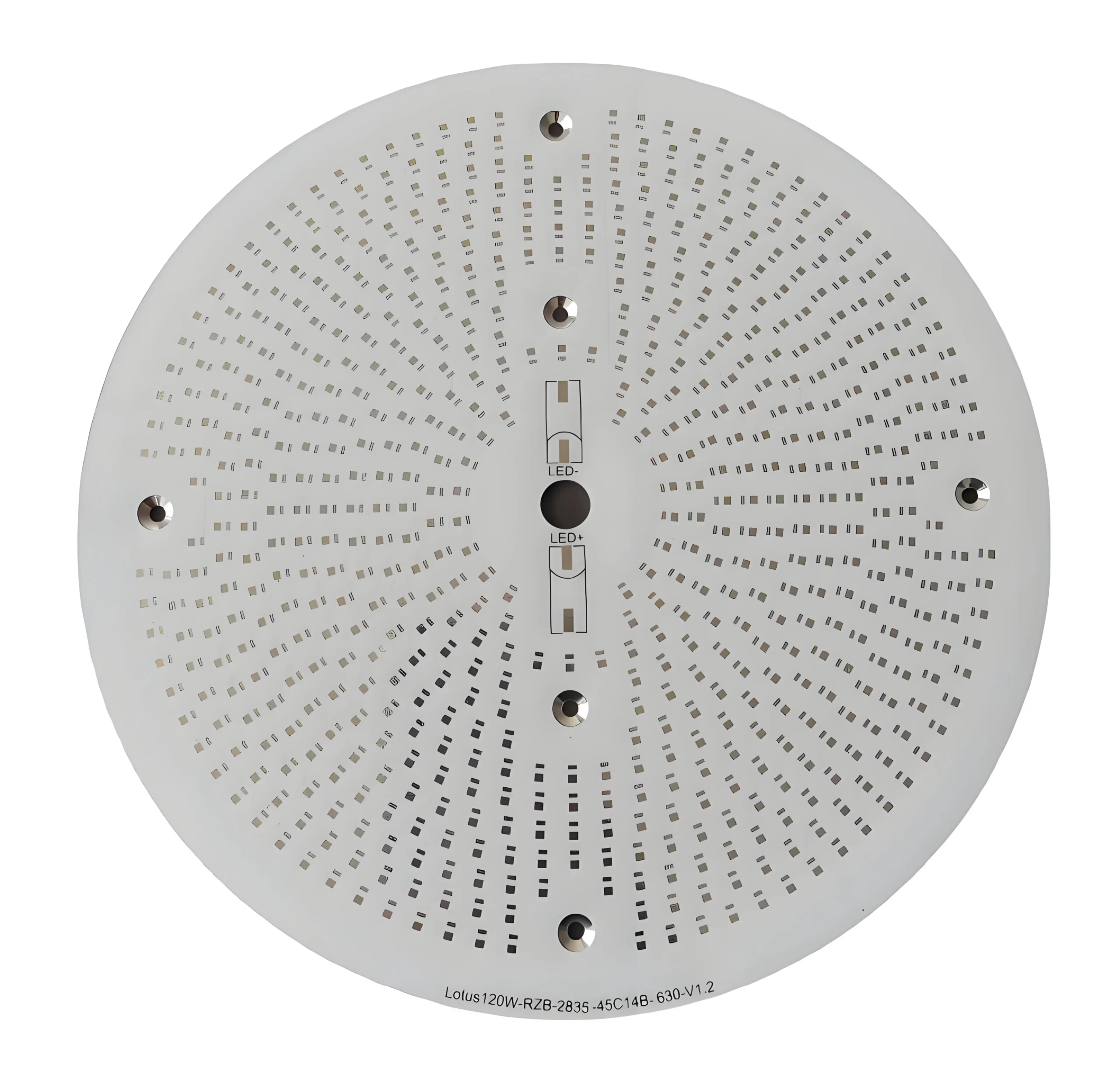
An aluminum PCB (also called MCPCB — Metal Core PCB) replaces the FR4 core with an aluminum base, topped with a thin dielectric layer and copper circuit. The aluminum base acts as a heat spreader, pulling heat away from components far faster than FR4 can.
| Property | FR4 PCB | Aluminum PCB (MCPCB) |
|---|---|---|
| Base material | Glass-fiber epoxy laminate | Aluminum + dielectric layer |
| Thermal conductivity | ~0.3 W/mK (typical) | 1.0 – 3.0 W/mK (standard dielectric) |
| Best for | General rigid electronics | Heat-dissipation applications |
| Typical applications | Control boards, communication modules, LED strips | LED lighting, power modules, automotive electronics |
When Is FR4 PCB Enough?
Many projects do not need an aluminum PCB. If your board has:
- Low to moderate power density
- Components that do not generate concentrated heat (logic, sensors, low-power drivers)
- Adequate air movement or an external heatsink
- No requirement to keep a specific junction temperature under load
...then FR4 is likely sufficient. FR4 is also the right choice when cost is the dominant factor and thermal load is modest.
The key question: is there a concentrated heat source on the board? If yes, the heat path matters — and that is where aluminum PCB becomes worth reviewing.
The four conditions that keep you on FR4
Stated positively, FR4 stays the right answer while all four of these are true:
- Total dissipation on the board is modest and spread over area, not concentrated in a package.
- The component's own thermal path (thermal pad, exposed pad, heatsink on top) does the work.
- Junction temperature stays inside the part's rating at the worst-case ambient, with margin.
- The enclosure has some route for the heat to leave — convection, chassis contact, or an external heatsink.
Break any one of them and the board itself becomes part of the thermal circuit. That is the moment to price a metal-core option, not before.
When Should You Review an Aluminum PCB?
You should evaluate an aluminum PCB when:
- LED or high-power components are present — LEDs, power modules, motor drivers, and automotive electronics all concentrate heat in a small area.
- The board must survive a high junction temperature — the dielectric layer and base material must move heat fast enough to keep components within spec.
- A thermal path is required — the aluminum base conducts heat to a heatsink, chassis, or enclosure more effectively than FR4.
For high-bay lights, LED lighting, and power electronics, aluminum PCB is often the standard choice because the thermal requirement is non-negotiable.
The Dielectric Layer Decides More Than the Aluminum Does
Buyers compare the aluminum base and stop there. In practice the dielectric layer — the thin insulating film between the copper circuit and the metal base — is the limiting component in the thermal path. It is also the part of an MCPCB quote that is most often left unspecified.
| Dielectric parameter | Typical range | Why it matters | What happens if you leave it unspecified |
|---|---|---|---|
| Thermal conductivity | ~1.0–3.0 W/mK for standard grades; higher for specialty films | Sets how much heat crosses from copper to the metal base | Supplier quotes the cheapest film that passes insulation test |
| Thickness | Tens of microns, commonly 75–150 µm | Thinner layer conducts better but lowers breakdown voltage | Either an over-thick layer (poor thermals) or a marginal one (hi-pot risk) |
| Breakdown voltage | Specified in kV, tested at a defined voltage and time | Determines the isolation margin for mains-referenced circuits | Compliance risk, and a safety issue rather than a quality issue |
| Thermal resistance | Derived from conductivity and thickness | The number that belongs in a thermal model | Model input becomes a guess, so the simulation is meaningless |
| Peel strength and Tg | Film-specific | Survival through reflow and thermal cycling | Delamination between copper and dielectric after assembly |
Two practical consequences. First, a higher-conductivity aluminum has no effect if the dielectric is thick. The two numbers multiply into thermal resistance; quoting one without the other tells you nothing. Second, high breakdown voltage and low thermal resistance pull in opposite directions. For mains-referenced designs the insulation requirement wins, and the answer is usually a thicker or higher-integrity dielectric with a larger copper area to compensate.
Cost: Where the Money Actually Goes
Aluminum boards cost more per square metre than FR4 at the same layer count, but per finished assembly the comparison can reverse. The honest way to compare is by cost driver, not by unit price.
| Cost element | FR4 | Aluminum (MCPCB) | Where the difference lands |
|---|---|---|---|
| Bare board | Baseline | Higher — special material, separate line, tighter process | Per-board price |
| Heatsink | Usually needed for power designs | Often reduced or eliminated — the base is the spreader | System bill of materials |
| Assembly | Standard SMT | Needs thermal profile control; aluminum mass absorbs heat | Rework rate and profile development |
| Mechanical | Board mounts, thermal pads, TIM | Direct chassis contact sometimes possible | Enclosure design and part count |
| Tooling and MOQ | Standard panel tooling | Metal routing and scoring add tooling complexity | Low-volume programmes |
| Thermal design effort | May need heatsink selection and TIM study | Dielectric and base thickness become the design variables | Engineering hours |
The decision rule: compare total cost per acceptable unit at the thermal target, not price per board. An aluminum board that removes a machined heatsink and two thermal pads often wins even at twice the bare-board price. An aluminum board that still needs the heatsink has paid twice.
Aluminum PCB vs FR4: What Comparison Articles Usually Miss
Five variables the tables leave out
Most articles compare only the thermal conductivity numbers. But real PCB sourcing decisions need more:
- Dielectric layer — the insulation between the copper circuit and the aluminum base. Its thermal conductivity, thickness, and breakdown voltage determine how much heat can actually pass. This is often the limiting factor, not the aluminum itself.
- Board thickness — aluminum PCB thickness affects both thermal performance and mechanical rigidity. A thicker base moves more heat but costs more.
- Fabrication — aluminum PCBs require different drilling, routing, and plating processes than FR4. Not every fabricator handles them equally.
- Cost — aluminum PCB costs more per board, but can reduce or eliminate the need for a separate heatsink, lowering total system cost.
- Assembly — the aluminum base can complicate soldering and reflow if the board is not handled correctly.
How to Choose: A Practical Checklist for Buyers
Use this checklist when you are comparing quotes or deciding on a material:
- Identify the heat source — which component(s) generate the most heat, and where are they located?
- Calculate or estimate the power density — is the heat concentrated or spread evenly?
- Check the required junction temperature — does the component spec require a specific thermal budget?
- Decide if a thermal path is needed — can the board conduct heat to a chassis, or does it need a heatsink?
- Compare the full cost — aluminum PCB vs FR4 + separate heatsink.
- Confirm fabricator capability — does your supplier run metal-core lines with controlled dielectric thickness?
What Are the Main Types of PCBs?
If you are comparing PCB types, the four main categories are:
- Rigid PCB — FR4 and other rigid laminates (most common)
- Flexible PCB — FPC, bends and folds
- Rigid-Flex PCB — combines rigid and flexible sections
- Metal-Core PCB — aluminum, copper, and other metal bases (this is where MCPCB sits)
The choice among them is driven by mechanical, thermal, and signal requirements — not by a single "best" material.
FAQ
Is there aluminum in a normal PCB?
No. A standard FR4 board contains glass cloth, epoxy resin and copper — no metal core. Aluminum appears only in metal-core boards (MCPCB), where a solid aluminum plate forms the base and a dielectric film separates it from the copper circuit. If a datasheet says "aluminum PCB", it means the base, not the copper.
What material is equivalent to FR4?
Nothing is interchangeable across the board. Within the same performance band, mid-Tg and high-Tg FR4 laminates are direct substitutes with better thermal margins. For higher temperatures, polyimide or BT-epoxy laminates take over, at higher cost and different process windows. For high frequency, PTFE-based laminates replace FR4 entirely because the dielectric loss is much lower.
Why is FR4 used in PCB?
Because it is dimensionally stable, mechanically strong, electrically adequate up to a few GHz, flame retardant, and cheap at scale. It also processes well in standard fabrication — drilling, plating, lamination and routing are all mature. Those four properties together are hard to beat for general electronics, which is why FR4 remains the default rather than the compromise.
Does an aluminum PCB cost more than FR4?
Per square metre, yes — the material, the separate metal-core line and the tighter process control all add cost. Per finished assembly, often no. When the aluminum base replaces a machined heatsink and thermal interface material, total system cost usually falls. Compare at the thermal target, not at bare-board price.
Can an aluminum PCB be assembled like an FR4 board?
Mostly yes, with two differences. The aluminum mass absorbs heat, so the reflow profile needs adjustment, especially on thin bases. And plated through-holes are restricted, so many designs are single-sided or SMT-only. Confirm both with the assembly house before release.
Why Choose YC PCB for Aluminum and FR4 PCBs?
- 20+ years of PCB/PCBA manufacturing experience
- 100,000+ m² monthly production capacity
- Complete metal-core line — standard aluminum, high-thermal aluminum (PROD-0202), 8W superconducting thermal aluminum (PROD-0203), single/double-sided aluminum, and copper-base substrates
- AOI + electrical testing + X-ray inspection capability
- ISO 9001 and UL quality systems
- No MOQ / No MOV for standard and prototype boards
- Ships to 20+ countries
Whether your project needs FR4 for cost efficiency or aluminum for thermal performance, our engineering team will help you pick the right material for your thermal budget.
Get a Quote — send us your Gerber and requirements, and we will confirm the right material, stack-up, and pricing.

 English
 Japanese
 French
 German
 Spanish
 Italian
 Portuguese
 Russian
 Dutch
 Turkish