

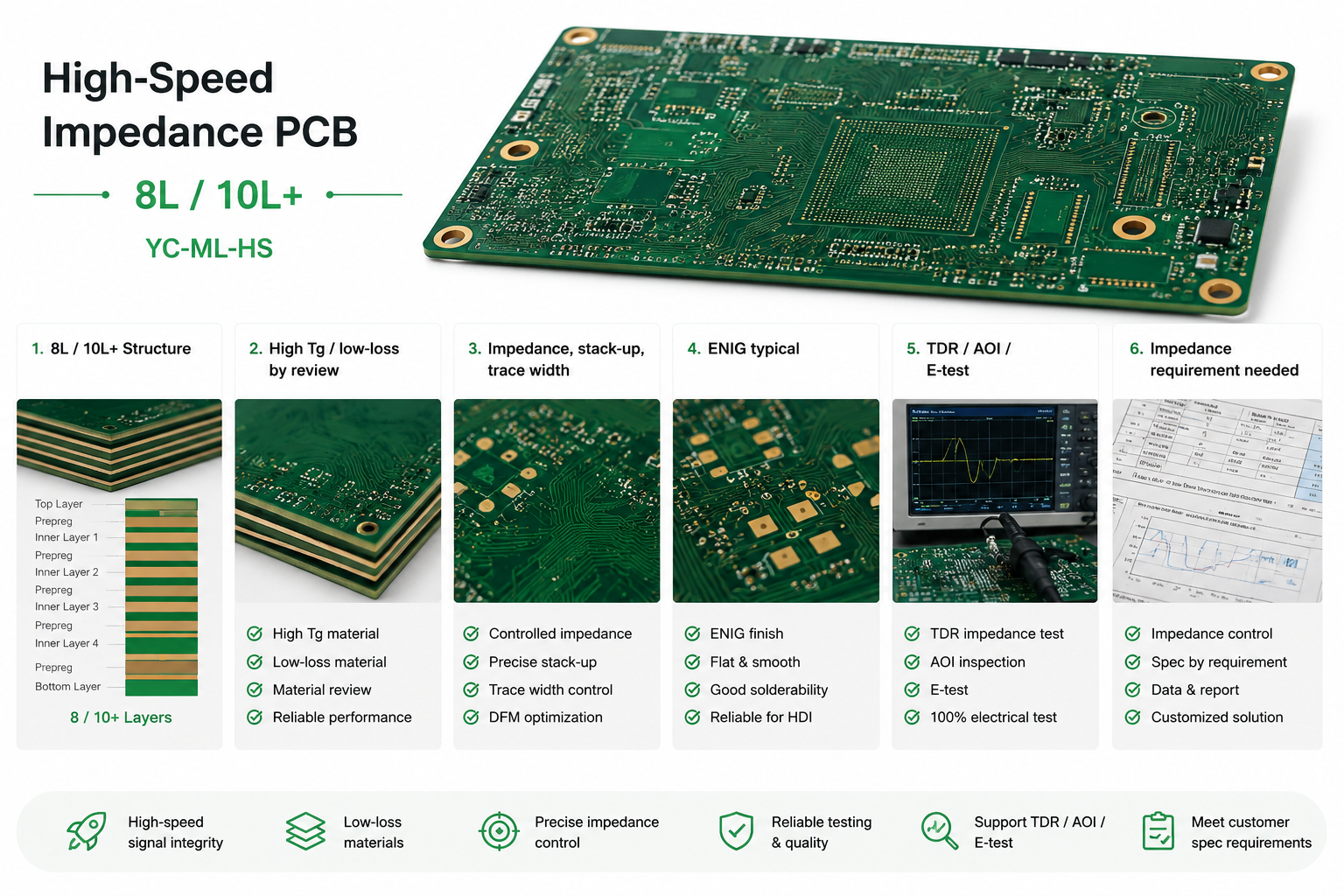
A controlled impedance board fails for a boring reason far more often than an exotic one: the stack-up on the fabrication drawing does not match the stack-up the design was simulated on. Trace width was calculated for one dielectric thickness; the factory built another; the measured impedance lands outside tolerance; the board works but the yield is bad and nobody can explain why.
Impedance is a stack-up outcome. This guide sets out what to confirm before fabrication — the seven points that decide whether the board you receive behaves like the board you simulated.

Why Impedance Is a Stack-Up Problem
Impedance of a trace is set by four physical quantities:
- Trace width — wider traces lower impedance
- Dielectric thickness between the trace and its reference plane — thicker dielectric raises impedance
- Dielectric constant (Dk) of the material — lower Dk raises impedance
- Copper thickness — thicker copper lowers impedance slightly and changes the effective geometry
A designer controls width. The fabricator controls thickness and, through material selection, Dk. Neither party controls impedance alone, which is exactly why the stack-up document has to be agreed rather than assumed.
The Seven Things to Confirm
1. Reference plane continuity
Every controlled-impedance trace needs a continuous reference plane beneath it (or above it). If the return path crosses a plane split, the impedance changes locally and the return current detours — creating an discontinuity and an emissions source.
Confirm on the stack-up drawing which layer is the reference for each signal layer, and check the layout for splits under those traces. This is a design check, but it fails at fabrication time.
2. Dielectric thickness per layer, not per board
"1.6 mm, 6 layers" does not define impedance. What defines it is the dielectric thickness between each signal layer and its reference plane — a number that varies layer by layer and is built from specific prepreg and core combinations.
Ask for the stack-up as a table: layer number, function, copper weight, dielectric material, dielectric thickness. If the fabricator returns a table with "core" and "prepreg" but no thickness values, the impedance calculation is not reproducible.
3. Material and Dk
Standard FR4 sits around Dk 4.2–4.6, and the exact value depends on resin content and glass style. For most digital designs under a few GHz this is manageable with tolerance. Above that, Dk and Df become design drivers and low-loss laminates enter the discussion.
Confirm which material the impedance calculation used. A fabricator who calculates with a generic Dk and builds with a different laminate has built a different board.
4. Single-ended versus differential, and the tolerance
State the target and the tolerance per net class:
| Type | Typical target | Typical tolerance | Key geometry |
|---|---|---|---|
| Single-ended | 50 Ω | ±10% | Width, dielectric height |
| Differential | 90 Ω / 100 Ω | ±10% | cURL Too many subrequests by single Worker invocation. To configure this limit, refer to https://developers.cloudflare.com/workers/wrangler/configuration/#limits |
| cURL Too many subrequests by single Worker invocation. To configure this limit, refer to https://developers.cloudflare.com/workers/wrangler/configuration/#limits | cURL Too many subrequests by single Worker invocation. To configure this limit, refer to https://developers.cloudflare.com/workers/wrangler/configuration/#limits | ±10% | cURL Too many subrequests by single Worker invocation. To configure this limit, refer to https://developers.cloudflare.com/workers/wrangler/configuration/#limits |
cURL Too many subrequests by single Worker invocation. To configure this limit, refer to https://developers.cloudflare.com/workers/wrangler/configuration/#limits.
cURL Too many subrequests by single Worker invocation. To configure this limit, refer to https://developers.cloudflare.com/workers/wrangler/configuration/#limits
cURL Too many subrequests by single Worker invocation. To configure this limit, refer to https://developers.cloudflare.com/workers/wrangler/configuration/#limits.
cURL Too many subrequests by single Worker invocation. To configure this limit, refer to https://developers.cloudflare.com/workers/wrangler/configuration/#limits.
cURL Too many subrequests by single Worker invocation. To configure this limit, refer to https://developers.cloudflare.com/workers/wrangler/configuration/#limits
Solder mask over a trace lowers impedance slightly; the effect is small at low frequency and larger on fine geometries. Surface finish matters mostly through thickness uniformity on fine pitch.
Neither is usually the dominant term, but both belong in the calculation note if the tolerance is tight.
7. Test coupons and who measures
Impedance is verified on a coupon built in the same panel, with the same stack-up and process. Confirm:
- Coupon design — same line width and gap as the real traces
- Coupon location — on the production panel, not a separate test board
- Measurement method — TDR, with the instrument and acceptance criteria stated
- Record — whether a measurement report comes with the shipment
Without a coupon, "controlled impedance" means the factory tried. With a coupon and a report, it means the board was verified.
A coupon requirement that is not written down becomes a default. Use this field list so the coupon is comparable between suppliers and between orders:
| Coupon field | What to state | Why it matters |
|---|---|---|
| Net class covered | Which impedance class each coupon structure represents | One coupon cannot verify three different geometries |
| Line width and gap | The same nominal geometry as the production traces | A coupon built to a different width verifies a different board |
| Layer pair | Which signal layer and which reference plane | Coupons built on the wrong layer pair measure the wrong dielectric |
| Position on panel | Production panel, at a defined location | A separate test board does not prove panel-level control |
| Acceptance limit | Target, tolerance, and what happens outside it | "Meets 50 Ω" without a band cannot fail |
| Measurement method | TDR, with instrument class and probe setup | Different methods give different numbers on the same trace |
| Sample frequency | Per panel, per lot, or per shipment | Determines whether you see one good coupon or a trend |
| Report format | Values per coupon, per panel, with pass/fail | A report without raw values cannot be trended |
What Usually Goes Wrong
The design was simulated on a stack-up the factory does not build. cURL Too many subrequests by single Worker invocation. To configure this limit, refer to https://developers.cloudflare.com/workers/wrangler/configuration/#limits.
cURL Too many subrequests by single Worker invocation. To configure this limit, refer to https://developers.cloudflare.com/workers/wrangler/configuration/#limits. cURL Too many subrequests by single Worker invocation. To configure this limit, refer to https://developers.cloudflare.com/workers/wrangler/configuration/#limits.
cURL Too many subrequests by single Worker invocation. To configure this limit, refer to https://developers.cloudflare.com/workers/wrangler/configuration/#limits. cURL Too many subrequests by single Worker invocation. To configure this limit, refer to https://developers.cloudflare.com/workers/wrangler/configuration/#limits.
cURL Too many subrequests by single Worker invocation. To configure this limit, refer to https://developers.cloudflare.com/workers/wrangler/configuration/#limits. cURL Too many subrequests by single Worker invocation. To configure this limit, refer to https://developers.cloudflare.com/workers/wrangler/configuration/#limits.
cURL Too many subrequests by single Worker invocation. To configure this limit, refer to https://developers.cloudflare.com/workers/wrangler/configuration/#limits. cURL Too many subrequests by single Worker invocation. To configure this limit, refer to https://developers.cloudflare.com/workers/wrangler/configuration/#limits.
cURL Too many subrequests by single Worker invocation. To configure this limit, refer to https://developers.cloudflare.com/workers/wrangler/configuration/#limits
- Stack-up table — layer, function, copper weight, material, dielectric thickness
- cURL Too many subrequests by single Worker invocation. To configure this limit, refer to https://developers.cloudflare.com/workers/wrangler/configuration/#limits — net class, target, tolerance, single-ended or differential
- Reference plane map — which plane serves which signal layer
- cURL Too many subrequests by single Worker invocation. To configure this limit, refer to https://developers.cloudflare.com/workers/wrangler/configuration/#limits — yes or no, and the acceptance criteria
- Measurement report — requested or not
- Layer transitions — where signals change reference layers, and whether return vias are present
- Note on material substitution — allowed or not, and with what approval
Where Most Impedance Guides Stop
They explain the physics well and stop before the commercial part. Three practical points they usually miss:
Impedance control has a cost structure of its own. It adds engineering time, coupon area, measurement and, sometimes, a tighter material specification. Quoting it as a line item is more honest than hiding it in the unit price.
Not every board needs it. A low-speed control board with no RF content and no fast edges does not benefit from a controlled stack-up. Asking for it "to be safe" adds cost without adding performance.
The factory's default stack-up is not a specification. Many fabricators build a standard 4- or 6-layer stack-up that happens to work for common designs. That is a starting point for discussion, not an answer to your impedance requirement.
Confirmation Checklist
- Send the stack-up you simulated on, with dielectric thickness per layer.
- Ask the fabricator to confirm it or propose an equivalent — in writing, before tooling.
- State impedance per net class with tolerance, not one global note.
- Map reference planes to signal layers; check for splits under controlled traces.
- Approve the coupon design and the measurement method.
- Confirm whether a measurement report ships with the boards.
- Record the approved stack-up as the baseline for repeat orders — and require notification if it changes.
FAQ
Do I need controlled impedance on every PCB?
No. Boards with slow edges, no RF content and no long buses usually meet their timing and EMC budget without it. Controlled impedance earns its cost when edge rates are fast enough that the trace behaves as a transmission line, or when a protocol specifies a characteristic impedance. Adding it "to be safe" adds engineering, coupon area and measurement without adding performance.
What happens if the fabricator changes the stack-up?
You get a different board. Dielectric thickness and Dk both change, so impedance shifts even if the trace geometry is identical. Any stack-up change should be treated as a design change: recalculate, re-approve and re-baseline for repeat orders.
Can impedance be verified without a coupon?
Only indirectly, and unreliably. Electrical test proves connectivity, not characteristic impedance. Without a coupon built on the production panel, you are relying on the fabricator's process claim. That may be acceptable for a prototype, but it is not evidence for a production lot.
Why does impedance shift between prototype and volume?
Because the process window moves. Prepreg press-out, etch factor and plating thickness all differ between a single panel and a production run, and each of them changes the finished geometry. A prototype that measures in tolerance only shows the design is viable; the volume run needs its own coupon data.
Why YC PCB
- cURL Too many subrequests by single Worker invocation. To configure this limit, refer to https://developers.cloudflare.com/workers/wrangler/configuration/#limits
- 6- to 32-layer rigid route plus HDI, so stack-up options are not limited to a fixed catalogue
- Stack-up-based impedance calculation with coupons and measurement available on request
- DFM review that checks the fabrication drawing against your stack-up before tooling
- FR4, high-frequency laminate, aluminum and copper metal-core in one supply chain
- AOI and electrical test on bare boards; X-Ray, ICT and FCT for assembly projects
- ISO 9001 and UL certification; RoHS compliance documentation on request
Get a Quote — Send your Gerber, drill, stack-up and impedance targets with layer count, quantity and target date. Our engineers reply with DFM notes, stack-up confirmation and pricing within one working day.


 French
 English
 Japanese
 German
 Spanish
 Italian
 Portuguese
 Russian
 Dutch
 Turkish
