

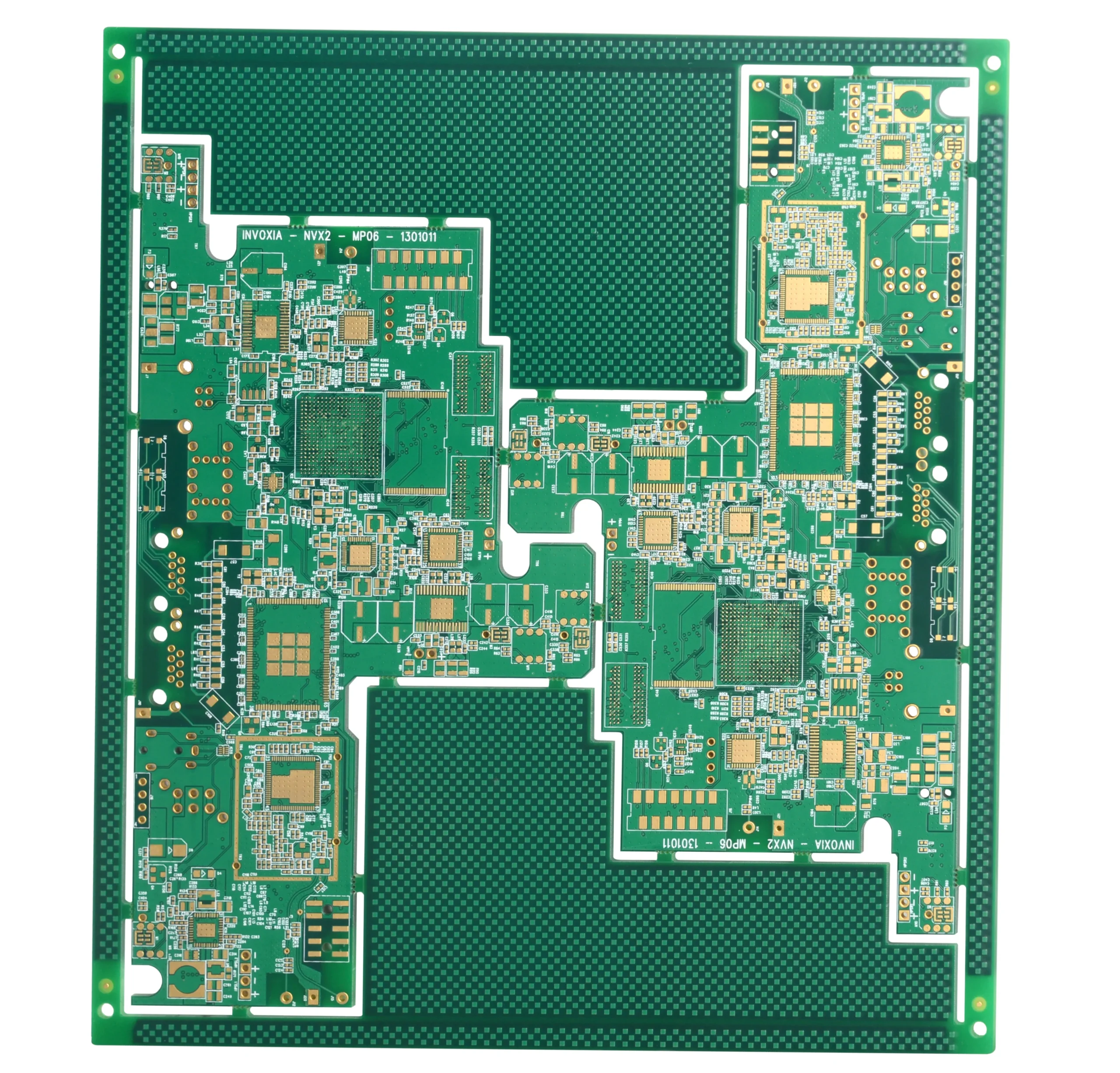
Two fabricators can quote the same Gerber with a 40% price difference and both be correct. On an impedance-controlled board, the gap usually is not margin — it is a different stack-up, a different coupon scope, or a different assumption about what "controlled" means.
This article is about the input side: what a controlled impedance PCB quotation actually requires, how each missing item changes the quote, and what to send so the first number you receive is the number you can build to. YC PCB quotes impedance-controlled multilayer and HDI boards daily, and the list below is drawn from the files that most often come back incomplete.
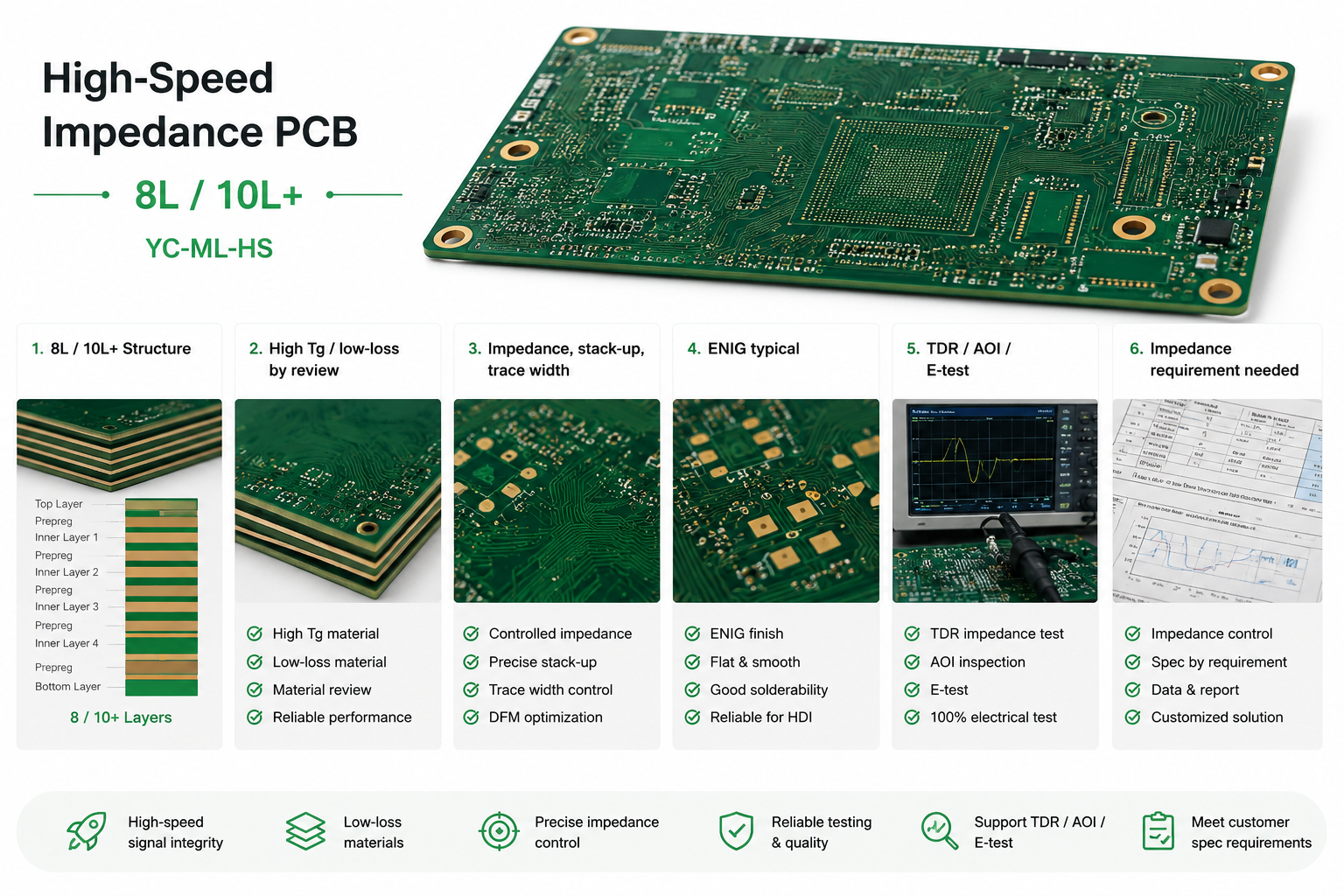
What "Controlled Impedance" Requires Beyond a Gerber
Five items a standard RFQ does not include
A standard PCB RFQ needs Gerber, drill, outline, layer count, material, copper weight, finish and quantity. An impedance-controlled order needs five more:
- cURL Too many subrequests by single Worker invocation. To configure this limit, refer to https://developers.cloudflare.com/workers/wrangler/configuration/#limits
- cURL Too many subrequests by single Worker invocation. To configure this limit, refer to https://developers.cloudflare.com/workers/wrangler/configuration/#limits — net class, target, tolerance, single-ended or differential
- Reference plane map — which plane serves which signal layer
- Material specification — including Dk/Df if the design is sensitive
- Coupon and measurement requirement — whether impedance is verified and reported
Without items 1 and 2, the quote can only cover fabrication. The impedance work is unpriced, and it will appear later as a change.
The RFQ Package, Item by Item
| Item | What to send | What goes wrong if missing |
|---|---|---|
| Gerber | RS-274X, single revision, all layers | Wrong layer count or stray data inflates the quote |
| Drill file | Excellon, with via classes identifiable | Via class cannot be priced; microvias mistaken for through holes |
| Board outline | Closed contour with tolerances | Panelisation and routing cost unknown |
| Stack-up | Layer, function, copper weight, material, dielectric thickness | Impedance cannot be calculated; quote is fabrication-only |
| cURL Too many subrequests by single Worker invocation. To configure this limit, refer to https://developers.cloudflare.com/workers/wrangler/configuration/#limits | Net class, target Ω, tolerance, SE or diff | Fabricator uses a default stack-up and hopes it lands in tolerance |
| Reference plane map | Signal layer → reference layer | Coupon design cannot reflect the real structure |
| Material spec | Laminate family, Tg, Dk/Df if relevant | Substitution risk; impedance calculation uses the wrong Dk |
| Copper weight | Per layer, outer and inner | Impedance geometry and etch capability both shift |
| Surface finish | Named type, lead-free requirement | Cost and assembly compatibility both affected |
| cURL Too many subrequests by single Worker invocation. To configure this limit, refer to https://developers.cloudflare.com/workers/wrangler/configuration/#limits | cURL Too many subrequests by single Worker invocation. To configure this limit, refer to https://developers.cloudflare.com/workers/wrangler/configuration/#limits | cURL Too many subrequests by single Worker invocation. To configure this limit, refer to https://developers.cloudflare.com/workers/wrangler/configuration/#limits |
| cURL Too many subrequests by single Worker invocation. To configure this limit, refer to https://developers.cloudflare.com/workers/wrangler/configuration/#limits | cURL Too many subrequests by single Worker invocation. To configure this limit, refer to https://developers.cloudflare.com/workers/wrangler/configuration/#limits | cURL Too many subrequests by single Worker invocation. To configure this limit, refer to https://developers.cloudflare.com/workers/wrangler/configuration/#limits |
| cURL Too many subrequests by single Worker invocation. To configure this limit, refer to https://developers.cloudflare.com/workers/wrangler/configuration/#limits | cURL Too many subrequests by single Worker invocation. To configure this limit, refer to https://developers.cloudflare.com/workers/wrangler/configuration/#limits | cURL Too many subrequests by single Worker invocation. To configure this limit, refer to https://developers.cloudflare.com/workers/wrangler/configuration/#limits |
How Each Missing Item Changes the Quote
The five gaps, and what they cost you
No stack-up: the fabricator quotes their standard build. It may not meet your impedance target, and the revision will cost more than the original quote plus engineering.
One global impedance note: the fabricator applies one geometry to the whole board. Net classes with different targets end up with compromises, and the coupon only proves the compromise.
No coupon requirement: the boards are built and electrically tested for connectivity. Impedance is never measured. If the design is marginal, you find out at EMC test.
Material left open: a generic FR4 with Dk 4.5 is assumed. If you later specify a low-loss laminate, both the material cost and the impedance geometry change.
No reference plane map: the coupon is designed on a simple two-layer structure that does not represent your actual stack-up. The coupon passes; the board does not.
Controlled Impedance PCB Requirements: The Short Version
If you only remember one thing: an impedance requirement must name a target, a tolerance, a net class and a layer. Everything else is detail.
Good: "Layer 3, single-ended, 50 Ω ±10%, referencing layer 2; layer 5, differential, 100 Ω ±10%, referencing layer 4 or 6."
Not usable: "Impedance controlled, 50 ohm."
The second version forces the fabricator to invent the rest, and whatever they invent becomes the specification.
Why Quotes Differ So Much
Four legitimate reasons, and one illegitimate one.
Legitimate:
- Different stack-up — more layers, thicker dielectric, or a build-up requiring an extra lamination cycle
- Different material — standard FR4 versus mid-Tg versus a low-loss laminate
- Different verification scope — coupon plus TDR report versus no coupon
- Different panel utilisation — a design that fits eight-up on a panel versus four-up changes the per-unit price substantially
Illegitimate: quoting a stack-up the factory cannot actually build to the stated tolerance. This shows up later as yield loss, a re-quote, or boards that fail incoming inspection.
Attributing the difference
When two quotes differ, work down this table before negotiating. Each row is a question you can ask both suppliers, and the answer tells you whether the gap is real work or a different scope.
| Difference source | Typical impact | How to verify it | Verdict |
|---|---|---|---|
| Layer count or stack-up | Large — extra material and a lamination cycle | Ask both to return the stack-up table they quoted on | cURL Too many subrequests by single Worker invocation. To configure this limit, refer to https://developers.cloudflare.com/workers/wrangler/configuration/#limits |
| cURL Too many subrequests by single Worker invocation. To configure this limit, refer to https://developers.cloudflare.com/workers/wrangler/configuration/#limits | cURL Too many subrequests by single Worker invocation. To configure this limit, refer to https://developers.cloudflare.com/workers/wrangler/configuration/#limits | cURL Too many subrequests by single Worker invocation. To configure this limit, refer to https://developers.cloudflare.com/workers/wrangler/configuration/#limits | cURL Too many subrequests by single Worker invocation. To configure this limit, refer to https://developers.cloudflare.com/workers/wrangler/configuration/#limits |
| cURL Too many subrequests by single Worker invocation. To configure this limit, refer to https://developers.cloudflare.com/workers/wrangler/configuration/#limits | cURL Too many subrequests by single Worker invocation. To configure this limit, refer to https://developers.cloudflare.com/workers/wrangler/configuration/#limits | cURL Too many subrequests by single Worker invocation. To configure this limit, refer to https://developers.cloudflare.com/workers/wrangler/configuration/#limits | cURL Too many subrequests by single Worker invocation. To configure this limit, refer to https://developers.cloudflare.com/workers/wrangler/configuration/#limits |
| Panel utilisation | Moderate — the array decides how many boards per panel | Ask for the panel drawing and the number-up | Legitimate; usually the biggest silent variable |
| Finish and surface requirements | Small — finish choice and thickness control | Compare the named finish, not the word "gold" | Legitimate but often avoidable |
| cURL Too many subrequests by single Worker invocation. To configure this limit, refer to https://developers.cloudflare.com/workers/wrangler/configuration/#limits | Small to moderate — 100% versus sampled, AOI scope | Ask for coverage per board type | Legitimate and easy to overlook |
| Quoted tolerance beyond capability | Appears as a low price now, a re-quote later | Ask what dielectric tolerance supports the target | Not legitimate |
Two practical notes. Panel utilisation is the item most often left out of a comparison, because it is invisible in a quote that only lists a unit price — a design that fits eight-up versus four-up changes the per-unit number more than most material choices. And a quote that is cheaper because the tolerance is unachievable is not cheaper; it is a quote for a different board.
The way to tell them apart: ask each supplier to return the stack-up they quoted on. Suppliers who send a table are quoting a build. Suppliers who send only a price are quoting a hope.
Where Impedance RFQs Commonly Go Wrong
The stack-up is sent as an image. A PDF or screenshot cannot be checked against a calculation. Send the table as data.
The tolerance is tighter than the process supports. ±5% impedance requires tight control of dielectric thickness, Dk and etch. It is achievable on some builds and not on others. Ask before assuming.
Impedance is requested on a 2-layer board with no reference plane. A microstrip needs a plane. Without one, the trace is not impedance-controlled in any meaningful sense, whatever the drawing says.
The coupon is designed by the fabricator alone. Coupons should mirror the production geometry. If the coupon line width differs from the real trace, it verifies a different board.
Verification is assumed to be free. TDR measurement, coupon area and reporting all have cost. Asking for them explicitly is cheaper than discovering them as a surcharge.
Checklist: Sending an Impedance-Controlled RFQ
- Freeze the design revision before sending files.
- Send the stack-up you simulated on, as a table with dielectric thickness per layer.
- Write the impedance table by net class, with tolerance and reference layer.
- Name the material and Tg, and state whether substitution is allowed.
- State copper weight per layer.
- Ask whether a coupon is included, and what the acceptance criteria are.
- Ask whether a TDR measurement report ships with the boards.
- Confirm the panelisation and whether coupon area affects the array.
- cURL Too many subrequests by single Worker invocation. To configure this limit, refer to https://developers.cloudflare.com/workers/wrangler/configuration/#limits.
- cURL Too many subrequests by single Worker invocation. To configure this limit, refer to https://developers.cloudflare.com/workers/wrangler/configuration/#limits.
FAQ
cURL Too many subrequests by single Worker invocation. To configure this limit, refer to https://developers.cloudflare.com/workers/wrangler/configuration/#limits
cURL Too many subrequests by single Worker invocation. To configure this limit, refer to https://developers.cloudflare.com/workers/wrangler/configuration/#limits.
cURL Too many subrequests by single Worker invocation. To configure this limit, refer to https://developers.cloudflare.com/workers/wrangler/configuration/#limits
Only if the design was simulated on something equivalent. A standard stack-up is a starting point that works for common geometry, not a specification for your impedance target. If you accept it, recalculate your widths against it first, or you have adopted a board you did not design.
Why YC PCB
- 20+ years of multilayer and impedance-controlled fabrication, with a 6- to 32-layer rigid route and HDI
- Stack-up-based impedance calculation, returned with the quotation so you can check the build
- Coupons and TDR measurement available on request, with results reported
- DFM review before tooling, checking the drawing against the stack-up
- FR4, high-frequency laminate, aluminum and copper metal-core in one supply chain
- AOI and electrical test on bare boards; X-Ray, ICT and FCT for assembly projects
- ISO 9001 and UL certification; NDA available for customer IP
Get a Quote — Send your Gerber, drill, stack-up table, impedance requirements and quantity. Our engineers reply with the stack-up we will build on, DFM notes and pricing within one working day.

 French
 English
 Japanese
 German
 Spanish
 Italian
 Portuguese
 Russian
 Dutch
 Turkish
