

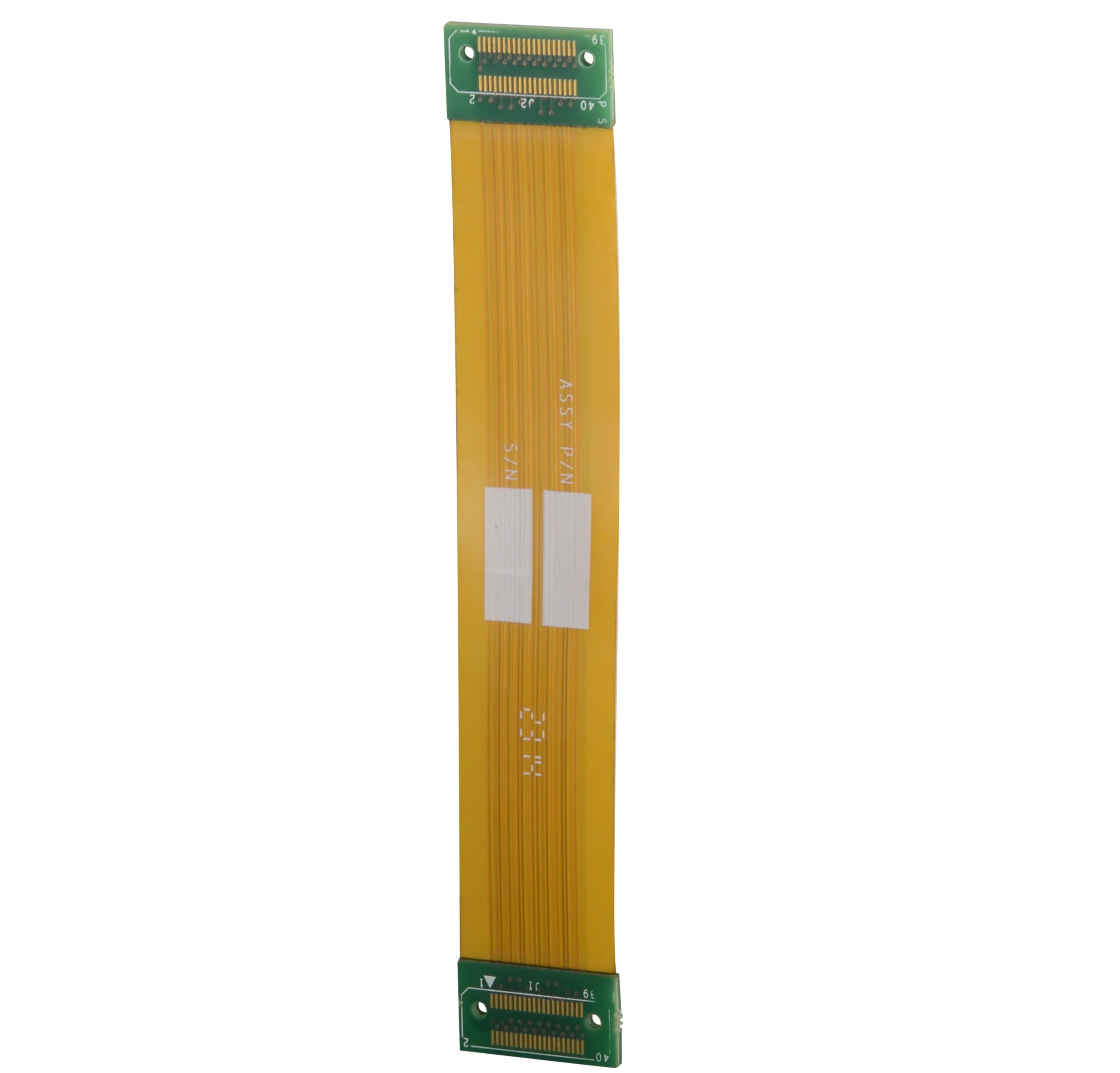
A flex PCB and a rigid-flex PCB solve the same problem — connecting two points in a product that cannot use a flat rigid board — but they solve it at different costs and with different assembly consequences. Choosing wrongly is expensive in both directions: rigid-flex when a flex would do adds lamination cycles you did not need, and flex when you needed rigid sections produces an assembly that cannot survive its own connector insertion force.
This guide gives the decision logic, then the cost and reliability consequences.

The Structural Difference
Flexible PCB (FPC): the entire board is flexible. Polyimide substrate, copper traces, coverlay instead of solder mask. Components, if any, sit on locally stiffened areas.
Rigid-Flex PCB: one continuous stack-up with rigid sections and flexible sections. The rigid sections carry components and vias; the flexible sections interconnect them. The flex core is the mechanical spine, and rigid layers are added in the rigid areas.
| cURL Too many subrequests by single Worker invocation. To configure this limit, refer to https://developers.cloudflare.com/workers/wrangler/configuration/#limits | Rigid-Flex-Leiterplatte | |
|---|---|---|
| Structure | Uniformly flexible | Rigid sections + flexible sections, one stack-up |
| Komponenten | Only on stiffened areas | Freely on rigid sections |
| Vias | Avoided in bend areas | Confined to rigid sections |
| Connectors | Needed at both ends | Often eliminated — flex replaces the cable |
| Assembly | Needs carrier or support | Standard SMT on rigid sections |
| Cost driver | Area, layers, coverlay, stiffeners | Number of rigid sections, lamination cycles, transition complexity |
| Typical use | Camera modules, sensor links, single-fold assemblies | Compact modules, medical devices, camera stacks, wearables |
The Decision Sequence
The five-question filter
Work through these five questions in order. The first one that gives a "no" answers the construction question.
1. Do components need to sit in more than one place, separated by a bend?
If yes, rigid-flex. Components cannot live in a bend area, so if you need parts on both sides of a fold, they need rigid real estate at both ends.
2. Can the assembly tolerate connectors at both ends?
A flex cable needs a connector at each end — two connectors, two mating operations, two failure points, and two sources of insertion-force damage. If the product is too small, too thin or too reliability-critical for that, rigid-flex eliminates both.
3. Is the bend static or dynamic?
Dynamic bending (repeated flexing in service) pushes toward a pure flex design with rolled annealed copper and a generous radius. Rigid-flex can handle static bends well; continuous flexing at a rigid-flex transition is a fatigue risk.
4. Is the total assembly cost or the unit board cost the decision?
Rigid-flex boards cost more. But they remove connectors, cable assembly labour, mating steps and test operations. On a small, high-volume assembly, the total can favour rigid-flex even when the board price does not.
5. Is the assembly process set up for thin flex?
Flex panels need carriers and fixtures; thin parts distort. If your assembly line is built for rigid boards, a pure flex design adds handling cost that does not appear in the board quote.
Choosing by Scenario
Most projects fall into one of the patterns below. Read down the middle column until the description matches, then check the reason — the reason is what makes the recommendation hold.
| Your situation | Construction | Why |
|---|---|---|
| cURL Too many subrequests by single Worker invocation. To configure this limit, refer to https://developers.cloudflare.com/workers/wrangler/configuration/#limits | cURL Too many subrequests by single Worker invocation. To configure this limit, refer to https://developers.cloudflare.com/workers/wrangler/configuration/#limits | cURL Too many subrequests by single Worker invocation. To configure this limit, refer to https://developers.cloudflare.com/workers/wrangler/configuration/#limits |
| cURL Too many subrequests by single Worker invocation. To configure this limit, refer to https://developers.cloudflare.com/workers/wrangler/configuration/#limits | cURL Too many subrequests by single Worker invocation. To configure this limit, refer to https://developers.cloudflare.com/workers/wrangler/configuration/#limits | cURL Too many subrequests by single Worker invocation. To configure this limit, refer to https://developers.cloudflare.com/workers/wrangler/configuration/#limits |
| cURL Too many subrequests by single Worker invocation. To configure this limit, refer to https://developers.cloudflare.com/workers/wrangler/configuration/#limits | cURL Too many subrequests by single Worker invocation. To configure this limit, refer to https://developers.cloudflare.com/workers/wrangler/configuration/#limits | cURL Too many subrequests by single Worker invocation. To configure this limit, refer to https://developers.cloudflare.com/workers/wrangler/configuration/#limits |
| Dense electronics plus a cable run, small enclosure | Rigid-flex | Removes two connectors, a cable and two mating operations |
| Connector-heavy interface, board must survive insertion force | Rigid-flex or flex with a metal stiffener | Connector retention needs rigid support at the contact area |
| Cost-driven, low volume, simple routing | Flex with stiffeners | Rigid-flex tooling rarely amortises at low volume |
| Mains-referenced or high-voltage interconnect | Rigid-flex, with dielectric and clearance designed in | Insulation and creepage are easier to control on a rigid section |
The pattern behind the table: rigid-flex wins on system integration, flex wins on simplicity. Almost every wrong choice is either paying for integration the product did not need, or asking a simple flex to do a job that needs rigid real estate.
Cost: Where the Money Actually Goes
Why the board quote misleads
| Cost element | cURL Too many subrequests by single Worker invocation. To configure this limit, refer to https://developers.cloudflare.com/workers/wrangler/configuration/#limits | Rigid-Flex-Leiterplatte |
|---|---|---|
| Base material | Polyimide, higher cost per area | Polyimide core plus rigid laminate in sections |
| Lamination | Single cycle | Multiple cycles, one per rigid build stage |
| Connectors | 2 per interconnect | Often zero |
| Cable assembly labour | Present | Eliminated |
| Test | Flex fixture required | Standard test on rigid sections |
| Yield risk | Bend-area and coverlay defects | Transition-zone and layer-registration defects |
The counter-intuitive part: rigid-flex is often cheaper at the assembly level and more expensive at the board level. If purchasing evaluates only the board quote, the comparison is wrong.
Are Flex PCBs More Expensive?
Per square metre, yes — typically more than FR4, because of polyimide material, coverlay lamination and the handling required for thin panels.
But "more expensive than what" matters:
- Compared with FR4: yes, meaningfully.
- Compared with FR4 plus a connector plus a cable assembly: often no, once the total is counted.
- Compared with rigid-flex: usually cheaper at board level.
cURL Too many subrequests by single Worker invocation. To configure this limit, refer to https://developers.cloudflare.com/workers/wrangler/configuration/#limits cURL Too many subrequests by single Worker invocation. To configure this limit, refer to https://developers.cloudflare.com/workers/wrangler/configuration/#limits cURL Too many subrequests by single Worker invocation. To configure this limit, refer to https://developers.cloudflare.com/workers/wrangler/configuration/#limits.
cURL Too many subrequests by single Worker invocation. To configure this limit, refer to https://developers.cloudflare.com/workers/wrangler/configuration/#limits
cURL Too many subrequests by single Worker invocation. To configure this limit, refer to https://developers.cloudflare.com/workers/wrangler/configuration/#limits
- cURL Too many subrequests by single Worker invocation. To configure this limit, refer to https://developers.cloudflare.com/workers/wrangler/configuration/#limits. cURL Too many subrequests by single Worker invocation. To configure this limit, refer to https://developers.cloudflare.com/workers/wrangler/configuration/#limits.
- cURL Too many subrequests by single Worker invocation. To configure this limit, refer to https://developers.cloudflare.com/workers/wrangler/configuration/#limits. cURL Too many subrequests by single Worker invocation. To configure this limit, refer to https://developers.cloudflare.com/workers/wrangler/configuration/#limits.
- Thermal performance is limited. Polyimide is a poor heat spreader compared with metal-core substrates. Power components on flex need local thermal management.
- Bend areas are fragile. A crease, a tight radius or a trace perpendicular to the bend becomes a field failure. Flex designs have less tolerance for mechanical abuse in assembly and service.
- Repair is difficult. Rework on flex damages coverlay and traces more easily than on rigid boards.
Are Flexible PCBs a Thing?
Yes — they are used in very high volume. Every smartphone camera module, most wearables, many medical catheters and a large share of automotive sensor links use flex circuits. The technology is mature; what varies is design discipline.
What is a flexible PCB called? Several names for the same thing: flex PCB, FPC (flexible printed circuit), flex circuit, and flexible printed circuit board. "FPC" is the most common in Asian manufacturing contexts.
Where the Choice Goes Wrong
Choosing flex to save board cost, then adding carriers, fixtures and stiffeners. The savings evaporate in assembly.
Choosing rigid-flex for a static one-time fold. A flex with a stiffener does the same job for less, if there are no components in the fold.
Putting components near a rigid-flex transition. The transition is where strain concentrates. Components there will crack.
Ignoring connector count in the comparison. Two connectors per interconnect is a real cost, and a real reliability item.
Designing a dynamic bend into a rigid-flex transition. Rigid-flex transitions are stiff. Continuous flexing at that boundary is a fatigue failure waiting to happen.
Comparing quotes without the same stack-up. A flex quote with two layers and a rigid-flex quote with six are not comparable numbers.
Decision Checklist
- Identify where components must sit relative to the bend.
- Count connectors in the flex-only option, and their assembly operations.
- Classify every bend as static or dynamic, with radius and cycle count.
- Compare total assembly cost, not board price.
- Confirm the assembly line can handle thin panels, or budget for carriers.
- Place all vias and components in rigid sections, at least a bend radius from any transition.
- State the mechanical envelope: 3D model, bend location, connector positions.
- Ask for both constructions quoted on the same stack-up basis, so the comparison is real.
FAQ
What is the main downside of a flexible PCB?
Mechanical fragility with poor thermal spreading. A flex cannot carry load without a stiffener, its bend areas tolerate less abuse in handling and service, and polyimide does not spread heat the way a metal base does. None of these is a problem if the design accounts for them; all of them become field failures if it does not.
Is rigid-flex always more reliable than flex plus connectors?
Not always, but it removes two failure points per interconnect: the connector and the mating operation. Where connector retention, insertion force or contamination are real risks — small devices, medical, high-vibration — that removal is usually worth more than the extra board cost.
Can I use a flexible PCB for a single fold?
Yes, and it is often the cheapest answer. A single-fold assembly needs no fatigue life, so electrodeposited copper is acceptable and the radius requirement is mild. Add a stiffener only where a connector or component needs support.
Why do flex and rigid-flex quotes come back so different in structure?
Because they are different products. A flex quote is area, layers, coverlay and stiffeners. A rigid-flex quote is rigid section count, lamination cycles and transition complexity. To compare them, ask both to quote on the same electrical stack-up and the same bend requirement.
Why YC PCB
- 20+ years of PCB manufacturing including FPC and rigid-flex, with double-layer and 4-layer flex constructions
- Both constructions quoted on a like-for-like stack-up so the cost comparison is meaningful
- Coverlay, stiffener, bend area and transition zone reviewed at DFM stage
- cURL Too many subrequests by single Worker invocation. To configure this limit, refer to https://developers.cloudflare.com/workers/wrangler/configuration/#limits
- cURL Too many subrequests by single Worker invocation. To configure this limit, refer to https://developers.cloudflare.com/workers/wrangler/configuration/#limits
- AOI and electrical test on bare boards; X-Ray, ICT and FCT for assembly projects
- ISO 9001 and UL certification; NDA available for customer IP
Get a Quote cURL Too many subrequests by single Worker invocation. To configure this limit, refer to https://developers.cloudflare.com/workers/wrangler/configuration/#limits.
Related reading
- cURL Too many subrequests by single Worker invocation. To configure this limit, refer to https://developers.cloudflare.com/workers/wrangler/configuration/#limits
- cURL Too many subrequests by single Worker invocation. To configure this limit, refer to https://developers.cloudflare.com/workers/wrangler/configuration/#limits
- cURL Too many subrequests by single Worker invocation. To configure this limit, refer to https://developers.cloudflare.com/workers/wrangler/configuration/#limits


 German
 English
 Japanese
 French
 Spanish
 Italian
 Portuguese
 Russian
 Dutch
 Turkish
