

Most FR4 orders are specified by copying the last one. That works until the product moves to a hotter environment, a lead-free reflow profile, a thicker copper layer or a longer service life — and then the board that "always worked" starts failing at the via wall or delaminating at reflow.
Choosing FR4 material is a five-variable decision: Tg, board thickness, copper weight, surface finish, and the process the board will survive. This guide gives the decision logic for each, plus what to write on the fabrication drawing so the supplier cannot substitute quietly. YC PCB has produced FR4 boards from single-sided LED strips to multilayer control boards for 20+ years.
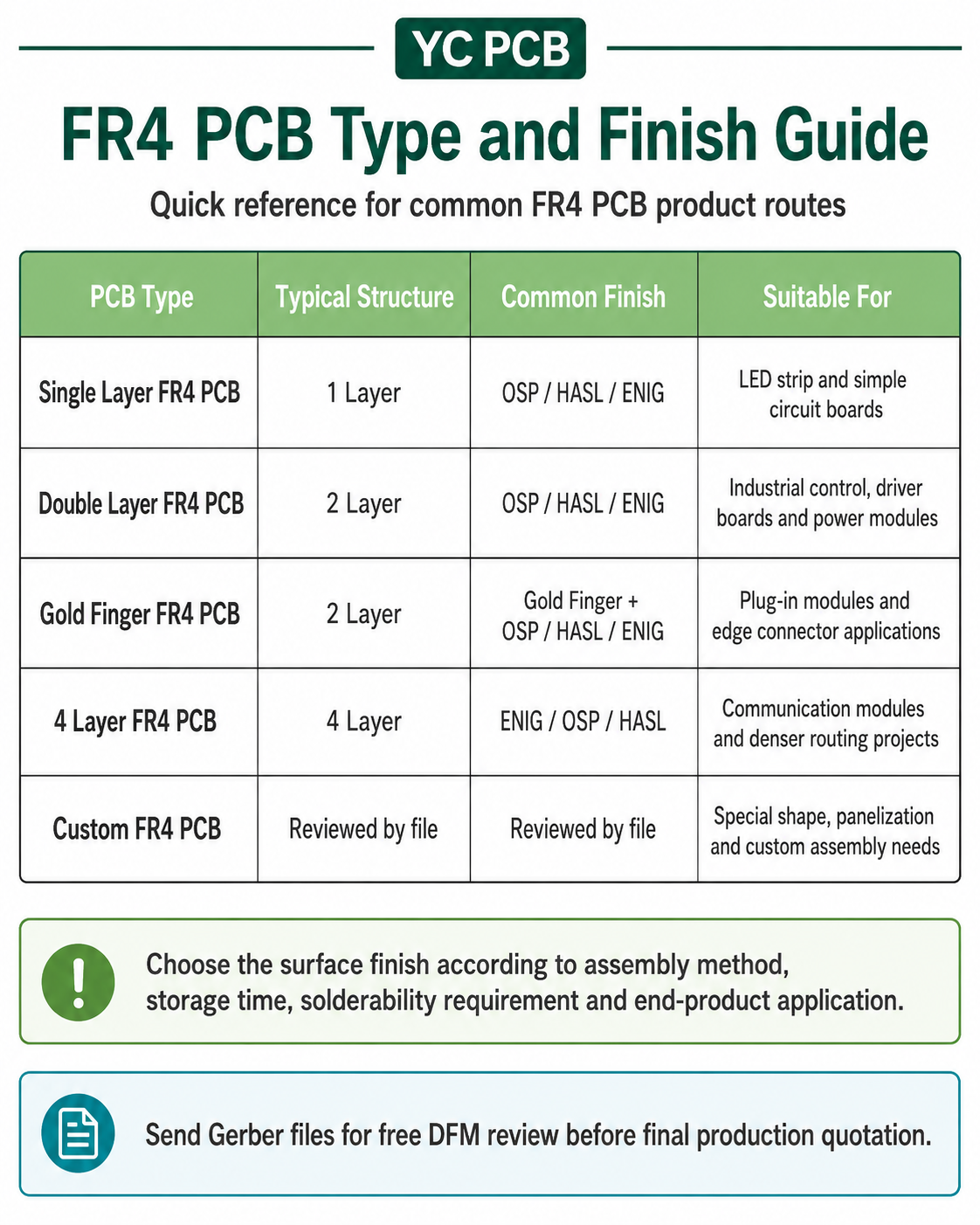
What Are the Different Types of FR4 PCB?
FR4 is a family, not a single material. The grades that matter commercially:
| Grade | Typical Tg | Where it is used | Watch out for |
|---|---|---|---|
| Standard FR4 | 130–140 °C | Consumer electronics, simple double-sided boards | Marginal at lead-free reflow and in hot enclosures |
| Mid-Tg FR4 | ~150 °C | General industrial, most multilayer | The default "safe" choice for many programmes |
| High-Tg FR4 | 170 °C and above | Lead-free assembly, thick boards, high layer counts, thermal cycling | Higher cost, different drill and lamination windows |
| Halogen-free FR4 | Varies, often high Tg | Programmes with halogen restrictions | Confirm Tg and Dk, not just the halogen claim |
| High-CTI FR4 | Varies | Power and high-voltage spacing | CTI grade must be stated, not assumed |
There are also FR4 variants tuned for specific behaviour — better dimensional stability, lower warp, higher tracking resistance. None of them is "better" in the abstract. The right grade is the one that matches your thermal exposure and your assembly process.
What Are the Material Properties That Actually Matter?
The four numbers that drive the decision
Four properties drive most FR4 selection decisions:
- Tg (glass transition temperature) — where the resin softens. Assembly temperature and operating temperature both matter. If your reflow peak is around 245 °C and your product runs hot, Tg 130 material is a lifetime calculation, not a safety margin.
- Td (decomposition temperature) — where the resin begins to break down. Relevant for thick boards and multiple lamination cycles.
- CTE (coefficient of thermal expansion) — especially Z-axis expansion, which stresses plated holes. Thick boards and small vias make this the limiting factor.
- Dk / Df (dielectric constant and loss) cURL Too many subrequests by single Worker invocation. To configure this limit, refer to https://developers.cloudflare.com/workers/wrangler/configuration/#limits cURL Too many subrequests by single Worker invocation. To configure this limit, refer to https://developers.cloudflare.com/workers/wrangler/configuration/#limits cURL Too many subrequests by single Worker invocation. To configure this limit, refer to https://developers.cloudflare.com/workers/wrangler/configuration/#limits.
cURL Too many subrequests by single Worker invocation. To configure this limit, refer to https://developers.cloudflare.com/workers/wrangler/configuration/#limits
cURL Too many subrequests by single Worker invocation. To configure this limit, refer to https://developers.cloudflare.com/workers/wrangler/configuration/#limits.
cURL Too many subrequests by single Worker invocation. To configure this limit, refer to https://developers.cloudflare.com/workers/wrangler/configuration/#limits
cURL Too many subrequests by single Worker invocation. To configure this limit, refer to https://developers.cloudflare.com/workers/wrangler/configuration/#limits cURL Too many subrequests by single Worker invocation. To configure this limit, refer to https://developers.cloudflare.com/workers/wrangler/configuration/#limits cURL Too many subrequests by single Worker invocation. To configure this limit, refer to https://developers.cloudflare.com/workers/wrangler/configuration/#limits.
Which Tg Do You Actually Need?
Tg is the number buyers quote most and understand least. It is the temperature at which the resin changes from glassy to rubbery — above it, the laminate expands faster and the dimensional stability that held your registration degrades.
| Your situation | Practical Tg band | Why | What goes wrong if under-specified |
|---|---|---|---|
| Consumer board, HASL, indoor, short life | 130–140 °C | Reflow exposure is brief and the product runs cool | Marginal at lead-free reflow; via cracking after a few years |
| General industrial, lead-free reflow, mixed SMT | ≥150 °C | Survives lead-free peak with margin, stable through assembly | Delamination or measling after reflow, warpage at assembly |
| Thick board (≥2.0 mm), 8+ layers, multiple lamination cycles | ≥170 °C | Multiple thermal excursions and long Z-axis expansion | Barrel cracks, layer-to-layer registration drift |
| Automotive, outdoor, high cycling duty | ≥170 °C plus low-CTE evaluation | Thermal cycling dominates the life model | Field failures that no incoming inspection would catch |
| High-voltage / power spacing | Grade set by CTI, Tg secondary | Tracking resistance is the governing property | Insufficient creepage margin at the specified voltage |
Two cautions. First, higher Tg is not free: drilling and lamination windows tighten, and cost rises. Second, Tg does not describe heat spreading. If a power device concentrates heat in one spot, a higher-Tg laminate only raises the failure threshold — it does not move the heat. That is a copper or metal-core decision.
Is FR4 Plastic?
Not in the everyday sense. FR4 is a glass-fibre reinforced epoxy laminate — woven glass cloth impregnated with epoxy resin and cured under pressure. It is a composite. The "FR" means flame retardant (typically rated V-0), and "4" identifies the grade.
Practically, this matters because FR4's behaviour comes from both components: the glass determines mechanical stability and CTE, the resin determines Tg, electrical behaviour and moisture uptake. That is why two laminates both sold as "FR4" can behave differently in a thermal cycling test.
What Is the Standard Thickness of FR4 PCB?
1.6 mm is the most common board thickness, but it is not a standard you should accept by default. Common range runs from 0.4 mm to 3.2 mm, with 0.8 mm, 1.0 mm, 1.2 mm and 2.0 mm also widely available.
Thickness interacts with three things:
- Connector and enclosure fit — edge connectors, card guides and slot dimensions are fixed by mechanics
- Via aspect ratio — hole depth divided by hole diameter. A 0.2 mm hole in a 2.0 mm board is a much harder plating problem than the same hole in a 1.0 mm board
- Warpage — thin multilayer boards with asymmetric copper are more prone to bow and twist
Finish thickness of copper and solder mask also changes the final dimension, so specify whether your thickness is before or after plating and mask.
cURL Too many subrequests by single Worker invocation. To configure this limit, refer to https://developers.cloudflare.com/workers/wrangler/configuration/#limits
cURL Too many subrequests by single Worker invocation. To configure this limit, refer to https://developers.cloudflare.com/workers/wrangler/configuration/#limits.
cURL Too many subrequests by single Worker invocation. To configure this limit, refer to https://developers.cloudflare.com/workers/wrangler/configuration/#limits
- cURL Too many subrequests by single Worker invocation. To configure this limit, refer to https://developers.cloudflare.com/workers/wrangler/configuration/#limits cURL Too many subrequests by single Worker invocation. To configure this limit, refer to https://developers.cloudflare.com/workers/wrangler/configuration/#limits
- cURL Too many subrequests by single Worker invocation. To configure this limit, refer to https://developers.cloudflare.com/workers/wrangler/configuration/#limits cURL Too many subrequests by single Worker invocation. To configure this limit, refer to https://developers.cloudflare.com/workers/wrangler/configuration/#limits
- cURL Too many subrequests by single Worker invocation. To configure this limit, refer to https://developers.cloudflare.com/workers/wrangler/configuration/#limits cURL Too many subrequests by single Worker invocation. To configure this limit, refer to https://developers.cloudflare.com/workers/wrangler/configuration/#limits
Heavy copper (2 oz and above) is not simply "more copper". It changes etch resolution, minimum trace/space, lamination pressure and drilling. If your design needs 2 oz or more, confirm the minimum feature size the fabricator can hold at that weight — the number is smaller than the one on their standard capability page.
Surface Finish: Choose by Assembly and Storage, Not by Price
| Finish | Good for | Limitation |
|---|---|---|
| HASL / lead-free HASL | Low-cost through-hole and mixed assembly | Uneven pad topography on fine pitch; thermal shock |
| cURL Too many subrequests by single Worker invocation. To configure this limit, refer to https://developers.cloudflare.com/workers/wrangler/configuration/#limits | Fine pitch SMT, long storage, flat pads | Black pad risk if process control is weak; cost |
| cURL Too many subrequests by single Worker invocation. To configure this limit, refer to https://developers.cloudflare.com/workers/wrangler/configuration/#limits | Short-life, single-reflow assemblies | Limited reflow cycles and shelf life; not for contact areas |
| Immersion silver | High-frequency and fine pitch | Tarnishes; packaging and storage control needed |
| Hard gold | Edge connectors, repeated insertion | Expensive; not a solderable finish |
The two questions that decide it: how many reflow cycles will the board see, and how long will it sit in storage? A board that is assembled twice and stored for a year is a different finish decision from one built and shipped in the same week.
What to Write on the Fabrication Drawing
Vague drawings produce substitutions. Put these on the drawing, not in an email.
| Parameter | Write this | Not this |
|---|---|---|
| Laminate | "FR4, Tg ≥ 150 °C, halogen-free" | "FR4" |
| Thickness | "1.60 mm ±10%, after finish" | "1.6 mm" |
| Copper weight | "Outer 1 oz, inner 0.5 oz, per layer" | "1 oz" |
| Surface finish | "ENIG, 3–5 µin gold, lead-free" | "gold" |
| Solder mask | "Green, LPI, halide-free" | "green" |
| cURL Too many subrequests by single Worker invocation. To configure this limit, refer to https://developers.cloudflare.com/workers/wrangler/configuration/#limits | "50 Ω ±10% on layers 1–2, 3–4; coupon required" | "50 ohm" |
| Acceptance | "IPC-A-600 Class 2, warp ≤0.75%" | "good quality" |
Anything left ambiguous will be filled in by the fabricator's default, and the default is chosen for cost, not for your thermal budget. If you do not know which value to specify, ask for the recommendation in writing and put the answer on the drawing — that turns a conversation into a specification.
cURL Too many subrequests by single Worker invocation. To configure this limit, refer to https://developers.cloudflare.com/workers/wrangler/configuration/#limits
cURL Too many subrequests by single Worker invocation. To configure this limit, refer to https://developers.cloudflare.com/workers/wrangler/configuration/#limits. cURL Too many subrequests by single Worker invocation. To configure this limit, refer to https://developers.cloudflare.com/workers/wrangler/configuration/#limits.
cURL Too many subrequests by single Worker invocation. To configure this limit, refer to https://developers.cloudflare.com/workers/wrangler/configuration/#limits. cURL Too many subrequests by single Worker invocation. To configure this limit, refer to https://developers.cloudflare.com/workers/wrangler/configuration/#limits.
cURL Too many subrequests by single Worker invocation. To configure this limit, refer to https://developers.cloudflare.com/workers/wrangler/configuration/#limits. cURL Too many subrequests by single Worker invocation. To configure this limit, refer to https://developers.cloudflare.com/workers/wrangler/configuration/#limits.
cURL Too many subrequests by single Worker invocation. To configure this limit, refer to https://developers.cloudflare.com/workers/wrangler/configuration/#limits. cURL Too many subrequests by single Worker invocation. To configure this limit, refer to https://developers.cloudflare.com/workers/wrangler/configuration/#limits.
Forgetting moisture. Boards absorb moisture; a board that is not baked before reflow can delaminate. For thick or high-layer-count boards, ask about pre-bake recommendation.
Selection Checklist
- Define the thermal exposure: reflow peaks, operating temperature, number of assembly passes.
- Pick laminate grade and Tg from that exposure, then confirm Dk/Df if the design has impedance or RF content.
- Choose board thickness from mechanics and via aspect ratio, not from habit.
- Set copper weight per layer from current and thermal spreading requirements.
- Choose surface finish from reflow count, storage duration and contact requirements.
- Write all five on the fabrication drawing with tolerances.
- Ask the fabricator to confirm the drawing before tooling, and to state any substitution they propose.
よくある質問
Is Tg 150 enough for lead-free reflow?
For most industrial boards, yes. Lead-free reflow peaks around 245–260 °C but the board is only near that temperature briefly, and Tg 150 material with adequate prepreg build survives it comfortably. The cases that need Tg 170 or above are thick boards, high layer counts with multiple lamination cycles, and products with long thermal-cycling duty.
Should I always choose the highest Tg available?
No. Higher Tg tightens the drill and lamination windows, raises cost, and does nothing for a heat-spreading problem. Choose the lowest Tg that survives your reflow profile, operating temperature and cycling duty with margin — then spend the difference on copper weight or a better finish.
Can a fabricator substitute a different FR4 grade without telling me?
They should not, but substitutions happen when the drawing only says "FR4". Prevent it by naming grade, Tg and, where relevant, halogen-free status on the drawing, and by asking for the material declaration with the delivery. A change-notification agreement closes the gap.
Does FR4 thickness affect impedance?
Yes, through the dielectric thickness per layer rather than the total board thickness. Two 1.6 mm boards can carry very different dielectric thickness between layer 1 and 2, which changes impedance and via aspect ratio. That is why the stack-up, not the board thickness, is the document that governs impedance.
Why YC PCB
- 20+ years of FR4 fabrication, from single-sided LED boards to multilayer control and communication boards
- Multilayer route from 6 to 32 layers, plus HDI where BGA density requires it
- FR4, aluminum, copper metal-core, high-frequency and flex constructions in one supply chain, so material advice is not limited to one substrate
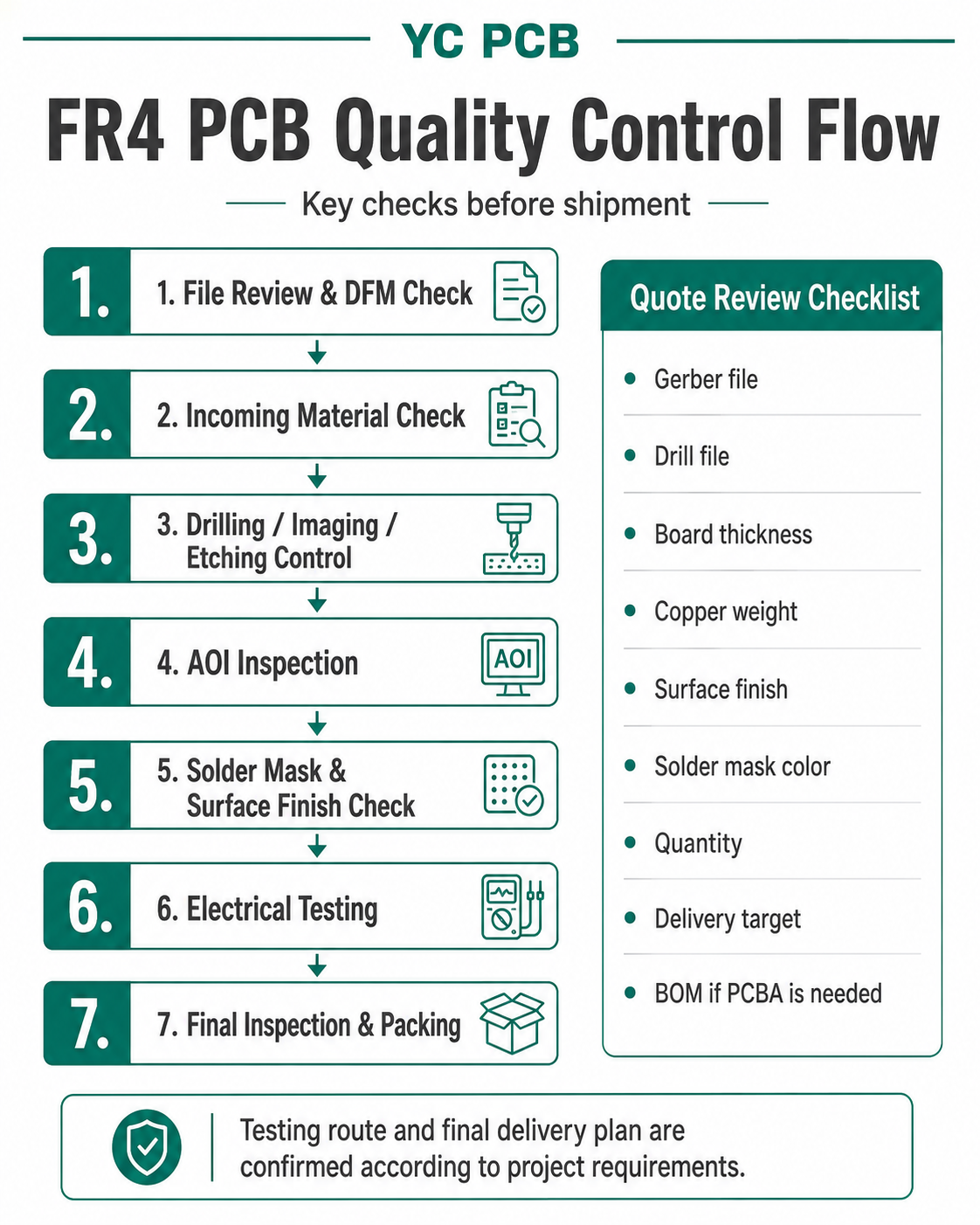
- DFM review before production; fabrication drawing checked against your stack-up
- AOI and electrical test on bare boards; impedance coupons available on controlled-impedance orders
- ISO 9001 and UL certification; RoHS compliance documentation on request
- No MOQ / No MOV on standard boards, with special laminates quoted per project
Get a Quote — Send your Gerber, the material and finish you intend to use, layer count, quantity and target date. Our engineers reply with DFM notes, material alternatives and pricing within one working day.

 Japanese
 English
 French
 German
 Spanish
 Italian
 Portuguese
 Russian
 Dutch
 Turkish
