

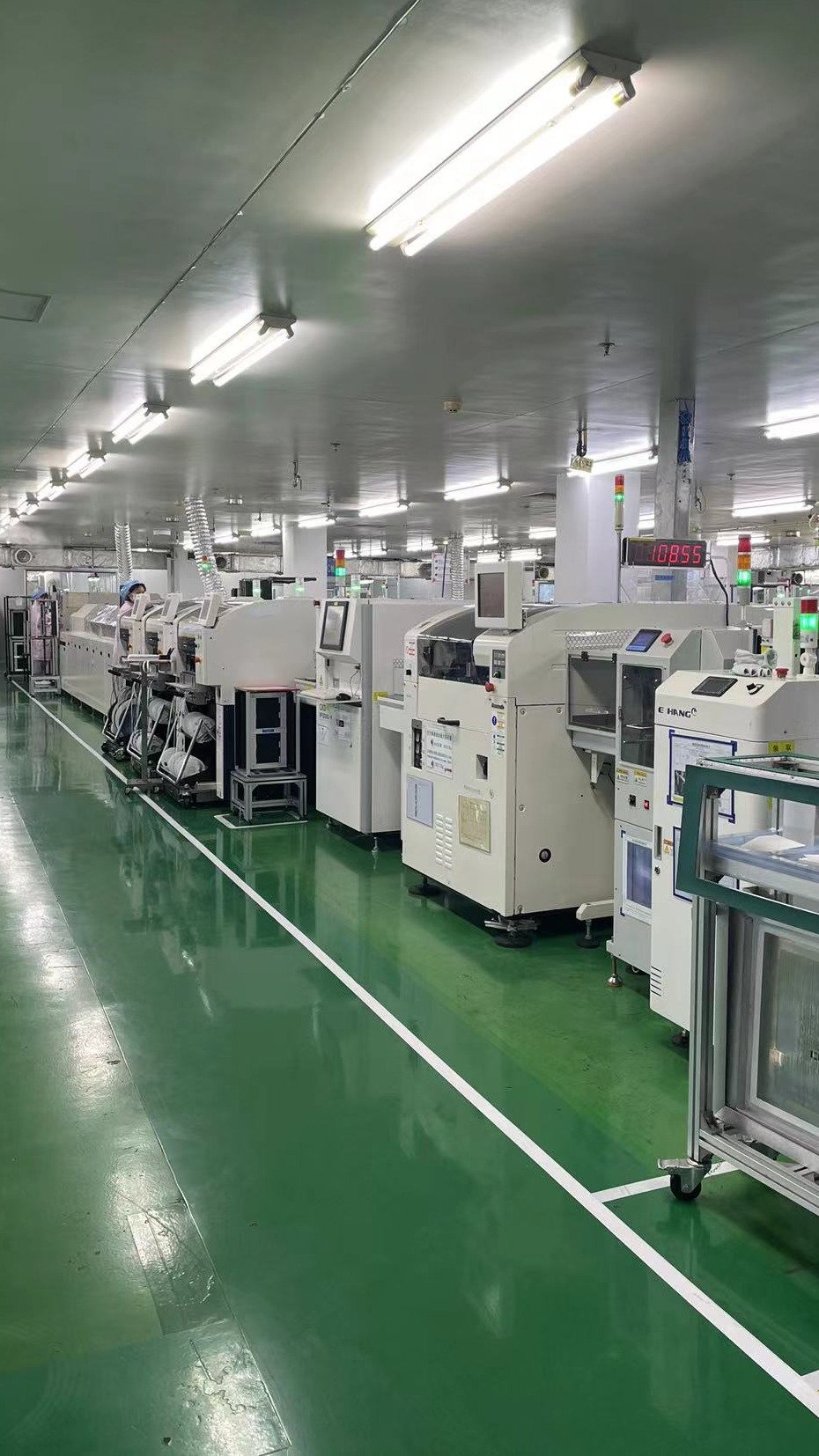
Surface mount technology is the dominant way electronics are assembled today: components are placed onto pads on the board surface and soldered in a reflow oven, with no leads passing through the board. Nearly every consumer product built in the last thirty years uses it.
But a definition alone does not help you specify an order. What matters for a buyer is what SMT requires as input, what it can and cannot do well, and where the process limits show up in cost and yield.

What Is Surface Mount Technology?
SMT is a mounting and soldering method: components sit on the surface of the board, solder paste is printed onto the pads, and the assembly is heated so the paste melts and forms the joint.
The alternative — through-hole technology — passes component leads through drilled holes and solders them on the other side. Both are still used, often on the same board.
| SMT | Through-hole | |
|---|---|---|
| Component mounting | On the pad, surface | Leads through the board |
| Solder method | Reflow paste | Wave, selective or hand |
| Typical components | Resistors, capacitors, QFN, BGA, SOIC | Connectors, transformers, large capacitors, relays |
| Density | Alto | Basso |
| Mechanical anchoring | None beyond the joint | Physical anchoring through the board |
| Automazione | Alto | Inferiore |
What Is the Difference Between SMD and SMT?
This is the most common confusion, and it matters in a quotation.
- SMT is the technology — the process of surface mounting.
- SMD is the device — a specific component designed for that process.
So "SMT assembly" describes a process capable of placing SMD parts. A quote for SMT assembly does not automatically include through-hole content, hand soldering, or test. Those are separate line items.
SMT and SMD are not the same thing; SMT and THT are the two parallel processes.
Why Is SMT Used?
Five reasons, and they compound:
- Density. Surface mount parts are smaller and can be placed on both sides, so a given board area holds far more function.
- Automation. Pick-and-place machines handle thousands of placements per hour with high repeatability. Labour cost per joint is low at volume.
- Cost at volume. Once the stencil and programme exist, incremental boards are cheap.
- Electrical performance. cURL Too many subrequests by single Worker invocation. To configure this limit, refer to https://developers.cloudflare.com/workers/wrangler/configuration/#limits.
- cURL Too many subrequests by single Worker invocation. To configure this limit, refer to https://developers.cloudflare.com/workers/wrangler/configuration/#limits. cURL Too many subrequests by single Worker invocation. To configure this limit, refer to https://developers.cloudflare.com/workers/wrangler/configuration/#limits.
cURL Too many subrequests by single Worker invocation. To configure this limit, refer to https://developers.cloudflare.com/workers/wrangler/configuration/#limits
cURL Too many subrequests by single Worker invocation. To configure this limit, refer to https://developers.cloudflare.com/workers/wrangler/configuration/#limits.
cURL Too many subrequests by single Worker invocation. To configure this limit, refer to https://developers.cloudflare.com/workers/wrangler/configuration/#limits
cURL Too many subrequests by single Worker invocation. To configure this limit, refer to https://developers.cloudflare.com/workers/wrangler/configuration/#limits
cURL Too many subrequests by single Worker invocation. To configure this limit, refer to https://developers.cloudflare.com/workers/wrangler/configuration/#limits
cURL Too many subrequests by single Worker invocation. To configure this limit, refer to https://developers.cloudflare.com/workers/wrangler/configuration/#limits. There is no lead anchoring the component to the board. Under vibration, thermal cycling or cable pull, an SMT joint is the only thing holding the part. This is why connectors and heavy parts are often still through-hole.
2. Hidden joints cannot be inspected visually. BGA and QFN joints sit under the package. They require X-Ray, which is an added cost and an added specification item.
3. Thermal stress during reflow. Components and board expand differently during the reflow excursion. Large packages and thick boards are more susceptible to warpage and joint stress.
4. Rework is harder. Replacing a BGA needs hot air or IR with a reballing capability; a fine-pitch QFN needs a controlled profile and often a stencil. Rework policy is therefore part of the assembly contract.
5. Moisture sensitivity. Many SMD packages absorb moisture and must be baked or stored dry before reflow, or they crack ("popcorning"). This is a process control requirement, not a design issue.
The Failure Modes SMT Actually Produces
Knowing the process's characteristic failures is more useful than knowing its advantages, because each one maps to an inspection point you can specify.
| Failure mode | What causes it | Where it is caught | How to prevent it |
|---|---|---|---|
| Insufficient paste | Stencil aperture too small, paste dried, poor release | SPI, before placement | Aperture design and paste life control |
| Bridging | Excess paste, poor gasketing, fine pitch without adjustment | SPI or AOI | Aperture reduction, stencil thickness choice |
| Tombstoning and skew | Uneven paste, asymmetric pad heating, fast ramp | AOI | Pad symmetry, profile tuning |
| Cold or grainy joint | Profile too fast, insufficient soak, thermal mass ignored | AOI, sometimes only at test | Profile developed on the real board, not a coupon |
| Head-in-pillow | Warped package plus oxidised paste; joint looks formed but is open | X-Ray or functional test | Warpage control, profile, paste activity |
| Voiding under thermal pad | Flux trapped under a large pad | X-Ray | Via placement in the pad, profile, paste pattern |
| Popcorning | Absorbed moisture expanding at reflow | Visible crack, or latent | Dry storage, bake before use, MSL control |
| cURL Too many subrequests by single Worker invocation. To configure this limit, refer to https://developers.cloudflare.com/workers/wrangler/configuration/#limits | cURL Too many subrequests by single Worker invocation. To configure this limit, refer to https://developers.cloudflare.com/workers/wrangler/configuration/#limits | AOI | cURL Too many subrequests by single Worker invocation. To configure this limit, refer to https://developers.cloudflare.com/workers/wrangler/configuration/#limits |
cURL Too many subrequests by single Worker invocation. To configure this limit, refer to https://developers.cloudflare.com/workers/wrangler/configuration/#limits. cURL Too many subrequests by single Worker invocation. To configure this limit, refer to https://developers.cloudflare.com/workers/wrangler/configuration/#limits cURL Too many subrequests by single Worker invocation. To configure this limit, refer to https://developers.cloudflare.com/workers/wrangler/configuration/#limits. cURL Too many subrequests by single Worker invocation. To configure this limit, refer to https://developers.cloudflare.com/workers/wrangler/configuration/#limits, cURL Too many subrequests by single Worker invocation. To configure this limit, refer to https://developers.cloudflare.com/workers/wrangler/configuration/#limits.
cURL Too many subrequests by single Worker invocation. To configure this limit, refer to https://developers.cloudflare.com/workers/wrangler/configuration/#limits
| Input | Why |
|---|---|
| Gerber and drill | Fabrication of the bare board |
| BOM with MPNs | Component sourcing and verification |
| CPL / centroid | Placement coordinates and rotation |
| Assembly drawing | Polarity and orientation for polarised parts |
| Stencil data (from paste layer) | Paste printing |
| Test specification | What "pass" means |
| Package-specific notes | Fine-pitch, BGA, or unusual packages needing special handling |
The CPL rotation convention is the most frequent cause of first-article failure. Different EDA tools define 0° differently, so a file can be internally consistent and still place parts rotated.
The Inspection Chain
Three gates, three different defects
SMT quality is built at three points:
- SPI (solder paste inspection) — after printing, before placement. Catches insufficient or excess paste, misalignment. Most solder defects originate here.
- AOI (automated optical inspection) — after reflow. Catches missing parts, wrong parts, tombstoning, bridging, insufficient fillet.
- X-Ray — for hidden joints: BGA, QFN, Micro-BGA. Catches voids, bridging and alignment under the package.
A supplier who offers "AOI only" has no visibility into BGA joints. If your design has area-array packages, X-Ray belongs in the specification.
When SMT Is Not Enough
- Connectors that take insertion or pull force — specify through-hole, or an SMT connector with mechanical reinforcement
- Large, heavy components — thermal mass and mechanical load favour through-hole
- High-vibration environments — through-hole anchoring, or additional adhesive
- Parts unavailable in SMD — transformers, large electrolytics, high-voltage components
- Very low volume, high mix — hand assembly may be more economical than a full SMT setup
Mixed technology is the normal case: SMT for the dense logic, through-hole for the connectors and power components, assembled in a defined sequence.
Where Buyers Get SMT Wrong
Assuming "SMT assembly" includes everything. It does not include through-hole, test, programming, coating or box build unless stated.
Not specifying X-Ray for BGA. AOI cannot see under the package. Without X-Ray, joint quality is unverified.
Ignoring moisture sensitivity. cURL Too many subrequests by single Worker invocation. To configure this limit, refer to https://developers.cloudflare.com/workers/wrangler/configuration/#limits.
cURL Too many subrequests by single Worker invocation. To configure this limit, refer to https://developers.cloudflare.com/workers/wrangler/configuration/#limits. cURL Too many subrequests by single Worker invocation. To configure this limit, refer to https://developers.cloudflare.com/workers/wrangler/configuration/#limits.
cURL Too many subrequests by single Worker invocation. To configure this limit, refer to https://developers.cloudflare.com/workers/wrangler/configuration/#limits. cURL Too many subrequests by single Worker invocation. To configure this limit, refer to https://developers.cloudflare.com/workers/wrangler/configuration/#limits.
cURL Too many subrequests by single Worker invocation. To configure this limit, refer to https://developers.cloudflare.com/workers/wrangler/configuration/#limits. cURL Too many subrequests by single Worker invocation. To configure this limit, refer to https://developers.cloudflare.com/workers/wrangler/configuration/#limits.
cURL Too many subrequests by single Worker invocation. To configure this limit, refer to https://developers.cloudflare.com/workers/wrangler/configuration/#limits
- cURL Too many subrequests by single Worker invocation. To configure this limit, refer to https://developers.cloudflare.com/workers/wrangler/configuration/#limits.
- State which components are through-hole, so the quote covers the right processes.
- Specify the inspection scope: SPI, AOI, X-Ray, ICT, FCT.
- Confirm the moisture-sensitivity handling policy.
- Ask whether a first article with a photo report is included.
- Agree the rework policy, including which packages the supplier can rework.
- Scope everything beyond assembly: programming, coating, box build, packaging.
- Confirm the schedule drivers and re-confirm after components are booked.
FAQ
Is SMT better than through-hole?
For density, weight, automation and high-frequency performance, yes. For mechanical retention, no — a solder joint alone cannot match a lead through a hole. Most boards use both, and the correct answer is per component rather than per board.
Why does my SMT quote not include everything I expected?
Because "SMT assembly" is a process, not a project scope. Through-hole content, X-Ray, ICT, programming, conformal coating and box build are separate operations with separate labour and equipment. Read the scope line, not the headline.
What is the difference between AOI and X-Ray?
AOI inspects surfaces optically: missing parts, wrong parts, bridging, poor fillets. X-Ray looks through the package at hidden joints — BGA, QFN, Micro-BGA — where AOI sees only the package outline. A line with AOI only has no evidence about area-array joints.
Why does moisture matter in SMT?
Because absorbed moisture turns to steam during reflow and cracks the package from the inside. The part passes incoming inspection, fails at reflow, and the failure looks like a supplier defect. Dry storage, bake schedules and MSL tracking are the control, and they belong in the supplier's process description.
Why YC PCB
- 20+ years of PCB and PCBA manufacturing, exporting to 20+ countries
- SMT, THT/DIP and mixed-technology assembly in-house
- BGA, QFN and Micro-BGA support with X-Ray inspection for hidden joints
- AOI and electrical test on bare boards; ICT and FCT scoped per project
- BOM management and component sourcing, with alternates confirmed before build
- DFM/DFA review before production; NDA available for customer IP
- ISO 9001 and UL certification; RoHS compliance documentation on request
Get a Quote — Send your Gerber, BOM, CPL and assembly drawing, and tell us which components are through-hole. Our engineers reply with the assembly plan, DFM notes and pricing within one working day.


 Italian
 English
 Japanese
 French
 German
 Spanish
 Portuguese
 Russian
 Dutch
 Turkish
